



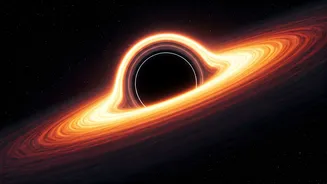


The Gentle Giant of the Galaxy
Most galaxies have a supermassive black hole at their core, and many of them are spectacularly active. These active galactic nuclei, or AGN, furiously consume surrounding gas and dust, blasting out incredible amounts of energy and light that can outshine
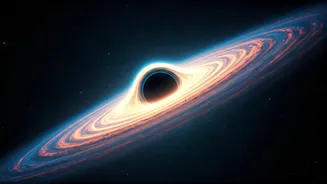
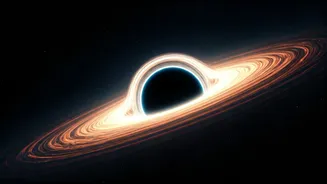
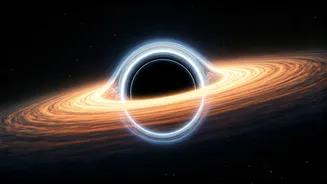
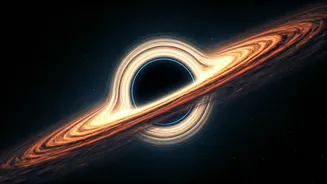
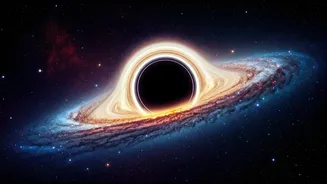
all the stars in the galaxy combined. Our own Sagittarius A, or Sgr A for short, is a different story. It has a mass of about four million suns, but it's remarkably faint. Astronomers call it 'quiescent' because it's on a starvation diet, consuming very little material. If it were a person, its food intake would be equivalent to a single grain of rice every million years. This is why the centre of the Milky Way isn't ablaze with the light of a quasar. For years, this relative calm has been a defining feature, making Sgr A a perfect laboratory for studying a typical, non-active black hole.
Flickers in the Darkness
Being quiet, however, doesn't mean being lifeless. Using advanced instruments like NASA's James Webb and Chandra X-ray telescopes, astronomers have been watching Sgr A closely, and they've seen it stir. The black hole frequently lets out flares, or bursts of radiation, across the electromagnetic spectrum. These are not the galaxy-spanning jets of an active black hole, but rather constant, smaller-scale 'fireworks'. Recent observations have revealed a surprising level of activity, from small, seconds-long flickers to several large, bright flares every single day. These flashes of light are our best window into the chaotic environment right at the edge of the event horizon, the point of no return.
What's Stirring the Beast?
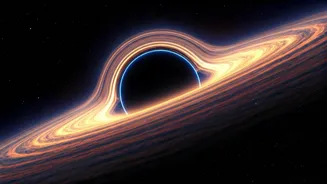
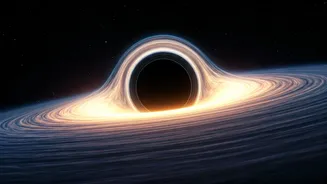
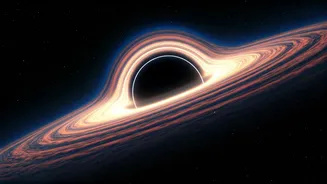
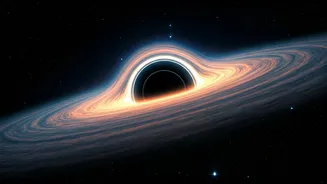
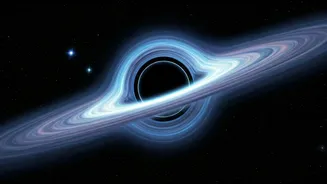
So, what's causing this constant simmering? The leading theory points to the intense and tangled magnetic fields in the hot gas swirling around the black hole. This superheated material, known as an accretion disk, is a turbulent place. Occasionally, magnetic field lines can snap and reconnect, releasing a tremendous amount of energy in a process called magnetic reconnection. This event accelerates nearby electrons to nearly the speed of light, causing them to emit the flares we see. It’s a process similar to the solar flares on our own Sun, but supercharged by the extreme gravity and energy of a supermassive black hole. The flares are like brief sparks that illuminate the innermost secrets of the black hole's accretion flow.
A Wind That's Been Blowing for Ages
The activity isn't just limited to light. For fifty years, scientists predicted that even a quiet black hole like Sgr A must produce a 'wind' — an outflow of material pushed away by the energy of its feeding process. Yet, finding it proved incredibly difficult, as our view is obscured by 26,000 light-years of galactic dust and gas. Recently, astronomers using the ALMA and Chandra observatories finally found the long-sought evidence. By mapping the gas around the galactic center, they discovered a vast, cone-shaped cavity where cold gas had been cleared out. The culprit is believed to be a hot wind blowing from Sgr A, which has been carving out this cavity for at least 20,000 years. This landmark discovery confirms that our black hole behaves much like others, just on a much more subtle scale.
Why Its Mood Swings Matter
Studying this paradox—a black hole that is both quiet and active—is crucial. Sgr A provides a unique, close-up view of the physics that govern the vast majority of supermassive black holes in the universe, which are believed to spend most of their lives in a similar quiescent state. These subtle flares and winds help scientists test fundamental theories of gravity and magnetism in extreme environments. They offer clues about how black holes feed and interact with their host galaxies, influencing star formation and galactic evolution. Each flicker and gust of wind from our galactic center is a piece of a puzzle, helping us understand not just the monster lurking next door, but the cosmic ecosystem of the entire Milky Way.