






Meet NASA’s Next Great Telescope
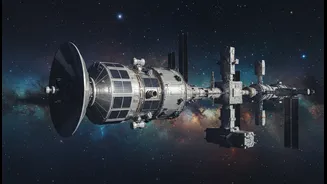
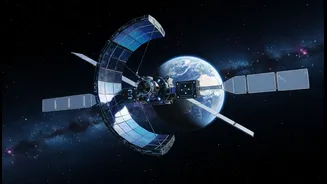
Scheduled for launch in the 2040s, the Habitable Worlds Observatory (HWO) has an audacious goal: to directly image Earth-like planets around sun-like stars and scan their atmospheres for signs of life. As the successor to the James Webb Space Telescope
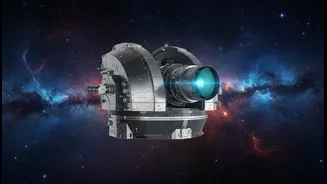
(JWST), this $11 billion mission represents the next great leap in our quest to answer whether we are alone in the universe. It will use a powerful internal coronagraph to block starlight by a factor of 10 billion, allowing it to see the faint light of planets that would otherwise be lost in the glare of their parent star. The primary objective is to analyze at least 25 potentially habitable worlds for chemical biosignatures like oxygen and methane.
The Lessons of Hubble and Webb
Past flagship observatories have offered powerful lessons in design and maintenance. The Hubble Space Telescope was famously launched with a flawed mirror, a crisis that was only averted because it was designed to be serviced by astronauts on the Space Shuttle. Those servicing missions dramatically extended its life, allowing for instrument upgrades that kept it at the forefront of science for over three decades. In contrast, the James Webb Space Telescope was not designed for servicing. It operates flawlessly now, but any significant hardware failure or gradual degradation from micrometeoroid impacts cannot be repaired. The HWO is being built on a new philosophy that combines the best of both worlds: the advanced power of a deep-space observatory with the longevity that servicing provides.
Enter the Robot Mechanics
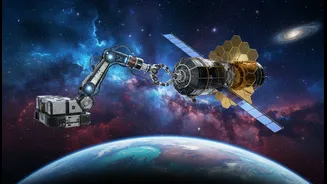
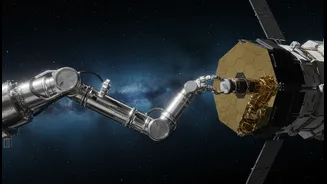
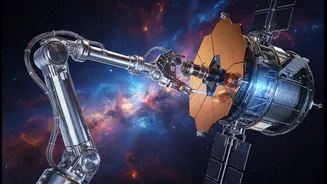
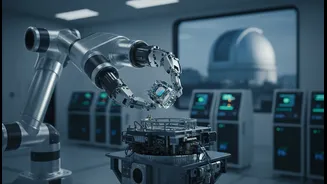
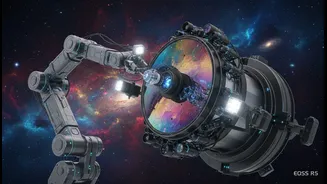
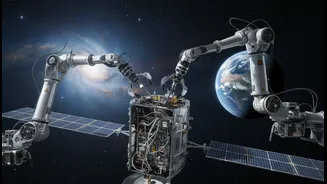
The HWO will be positioned 1.5 million kilometers from Earth at a location called Lagrange Point 2 (L2), the same region as JWST. This spot is ideal for astronomy but is far too distant for human astronaut servicing missions. The solution is to build the observatory from the ground up for robotic maintenance. NASA has mandated that the HWO must be serviceable, a fundamental shift in design philosophy. This means the observatory will be built with a modular architecture. Critical components like electronics and scientific instruments will be configured into standardized Line-Replaceable Units (LRUs) with docking interfaces and connectors optimized for robotic hands.
A Future-Proof Platform for Discovery
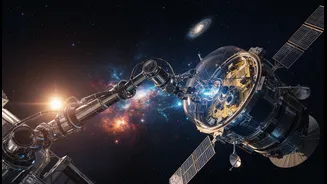
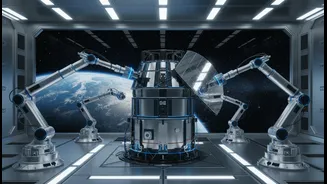
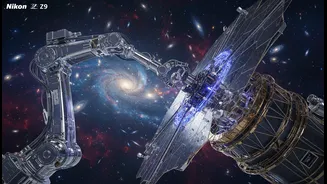
The plan for robotic servicing isn't just about repairs. It’s about creating a telescope that can evolve. Instead of being limited by the technology available at launch, the HWO will be upgradable. As new, more sensitive instruments are developed over the coming decades, robotic servicing spacecraft could be sent to swap out old modules for new ones. This approach ensures the observatory remains a cutting-edge scientific tool for much longer. In fact, if the final telescope design is too large to fit in a single rocket, robots might even be used to assemble parts of it in orbit. This strategic pivot turns the HWO from a single mission into a sustainable, long-term asset for discovery.
Fueling a New Commercial Industry
NASA’s mandate is also expected to be a major driver for the commercial space industry. By designing the HWO to be serviced, NASA is essentially creating a future market for companies that specialize in In-space Servicing, Assembly, and Manufacturing (ISAM). This emerging sector is focused on developing the robotic capabilities to repair, refuel, and upgrade satellites directly in orbit. The HWO project provides a clear, high-profile goal that will spur technological development and investment in this area, potentially lowering the cost and risk for all future space endeavors. It's a classic chicken-and-egg problem: service providers need serviceable satellites, and satellite operators need proven servicing technology. With HWO, NASA is building the chicken.