







Meet the Cosmic Detective: SPHEREx
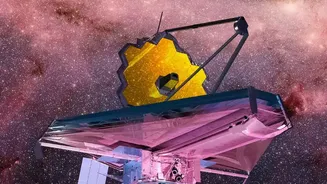
Launched in March 2025, NASA’s SPHEREx space telescope is on a grand quest to map the entire sky. Its full name, Spectro-Photometer for the History of the Universe, Epoch of Reionization, and Ices Explorer, hints at its ambitious goals. While its primary
mission includes studying the rapid expansion of the early universe and searching for the building blocks of life like water ice, it has proven to be an exceptional tool for another cosmic puzzle: brown dwarfs. By scanning the entire sky multiple times over its two-year mission, SPHEREx creates a comprehensive 3D map of the universe in 102 different colours of infrared light, which is invisible to the human eye. This allows it to spot objects that are too faint or distant for other telescopes.
The Curious Case of Brown Dwarfs
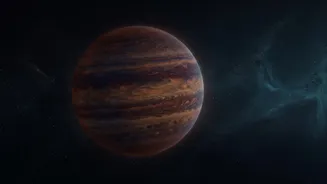
So, what exactly are these objects that have captured astronomers' attention? Often called 'failed stars', brown dwarfs form from collapsing clouds of gas and dust, much like stars do. However, they never accumulate enough mass to kickstart the sustained nuclear fusion of hydrogen in their cores, the process that makes stars shine. They typically have a mass between 13 and 80 times that of Jupiter. This leaves them in a fascinating middle ground: they are not stars, but they are also distinct from planets, often drifting through space alone without a host star. They glow dimly from the heat left over from their formation, slowly cooling over billions of years. Because they are so faint and cool, they are incredibly difficult to detect, and until recently, only a few dozen had been studied in detail.
Decoding the Cosmic Fingerprints
This is where SPHEREx's key technology comes into play: spectroscopy. Think of it like a cosmic prism. Just as a prism splits sunlight into a rainbow, SPHEREx splits the infrared light from celestial objects into its component wavelengths, creating a 'spectrum'. Different chemical elements and molecules absorb and emit light at very specific wavelengths, creating a unique barcode-like signature within this spectrum. By analyzing these light signatures, scientists can identify the chemical makeup of a brown dwarf's atmosphere. Recent findings from SPHEREx have revealed that these worlds have chemically rich atmospheres, containing molecules like water, methane, carbon monoxide, and carbon dioxide. These chemical fingerprints change as a brown dwarf ages and cools, providing clues about its life cycle.
Why These 'Failed Stars' Matter
Studying brown dwarfs isn't just about cataloging strange new worlds. They represent a crucial link between star formation and planet formation. Because many brown dwarfs float freely in space, they can be studied without the overwhelming glare of a nearby star, which often complicates observations of exoplanets. This makes them perfect laboratories for understanding atmospheric dynamics and chemistry that could be similar to gas giant planets in other solar systems. Furthermore, understanding how these objects form helps scientists refine their models of the mass distribution in our galaxy and the processes that lead to the birth of both the smallest stars and the largest planets. The data from SPHEREx is helping to test theoretical models about their evolution, particularly how their cloudy atmospheres change over time.