







The Uncompromising Demand for Safety
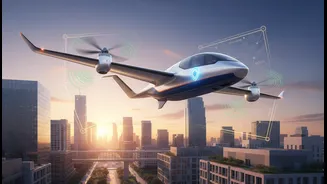
Before any passenger boards an air taxi, it must prove it is as safe as a commercial airliner. For a novel aircraft like the e200X—an electric Vertical Take-Off and Landing (eVTOL) vehicle—this is the single greatest challenge. Unlike traditional aircraft with
decades of data, eVTOLs feature new technologies like distributed electric propulsion (multiple small rotors) and advanced battery systems, each presenting unique failure scenarios. Regulators, led by India's Directorate General of Civil Aviation (DGCA), are building a new framework for this emerging class of vehicles. The safety benchmark is expected to be incredibly high: a probability of catastrophic failure of no more than one in a billion flight hours, the same standard applied to large passenger jets. Manufacturers must demonstrate that the aircraft can land safely even if one or more rotors or battery modules fail. The ePlane Company has already achieved a key milestone, securing a Design Organisation Approval from the DGCA, which clears the way for the intensive flight testing required to prove this level of reliability.
The Urban Noise Conundrum
Imagine hundreds of air taxis crisscrossing a city. Even if they are safer than helicopters, public acceptance will plummet if they are just as loud. Noise is a make-or-break issue for urban air mobility. The goal is for eVTOLs to be significantly quieter than conventional rotorcraft, blending into the ambient soundscape of a city. This requires a completely new approach to acoustic engineering and regulation. Aviation authorities worldwide are developing specific noise certification standards for eVTOLs, measuring their sound profile during take-off, hover, and cruise phases of flight. Brazil's aviation agency recently published proposed noise criteria for an eVTOL, a sign that regulators are taking the issue seriously before commercial operations begin. The e200X, built from lightweight carbon-fibre composites, is designed to be compact enough to operate from existing rooftops, placing it closer to people and making noise abatement even more critical. For the e200X and its peers to succeed, they must not only be safe to fly over but also quiet enough to live under.
Navigating the Certification Maze
Getting a new aircraft type certified is one of the most complex and expensive processes in modern industry. The journey from a prototype like the e200X to a commercially operating fleet is a marathon of testing, documentation, and regulatory scrutiny. The DGCA is responsible for issuing the final Type Certificate (TC), which formally declares an aircraft design as airworthy. This process involves multiple stages, from initial design approval to thousands of hours of flight tests under all conceivable conditions. The DGCA has issued guidance on type certification for eVTOLs and is collaborating with international bodies like the FAA in the US and EASA in Europe to harmonise standards. This ensures that an aircraft certified in India could potentially operate elsewhere, and vice-versa. However, India has its own unique operating environment, including extreme summer heat and monsoon weather, which requires specific validation. The ePlane Company is targeting certified flight tests by mid-2027, a timeline that highlights the long and meticulous path ahead. This regulatory gauntlet is designed to leave no stone unturned, ensuring every system is failsafe before the first ticket is sold.
India's Unique Flight Path
While safety, noise, and certification are global challenges, the e200X's route to market will also be shaped by local factors. The Indian government is actively promoting Advanced Air Mobility (AAM) as a solution to urban gridlock, aligning with national initiatives for smart, sustainable cities. However, significant hurdles remain, including a lack of dedicated landing infrastructure (vertiports) and the need to integrate these new vehicles into already dense airspace. The DGCA is working on creating a comprehensive framework that includes rules for vertiports and Unmanned Aircraft Traffic Management systems. To accelerate its entry, The ePlane Company plans to initially deploy the e200X for emergency medical services, a critical application where speed is paramount and could help build public trust and operational experience. With major players like IndiGo also entering the fray, India is poised to become a key market, but the success of homegrown pioneers like the e200X will depend on navigating this intricate web of global standards and local realities.