



A Glimpse into the Cosmic Dawn
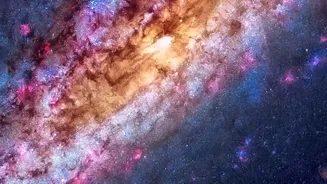
Imagine looking back over 12.5 billion years, to a time when the universe was just a toddler, only about 1.2 billion years old. That's precisely what astronomers have done with the galaxy J0148-4214. This isn't just any galaxy; it's a site of intense
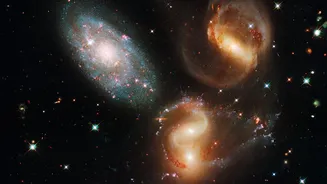
cosmic activity, likely formed from the collision of multiple smaller galaxies. These mergers are messy, violent events that trigger bursts of star formation and, as scientists have now confirmed, provide a feast for the supermassive black holes lurking at their cores. Finding such a system provides a crucial snapshot of a key process in galaxy evolution that theories have long predicted but never before witnessed in such detail in the early universe.
Hunting for Hungry Giants
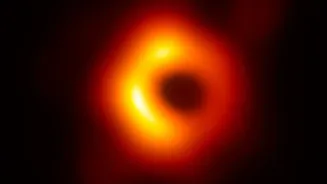
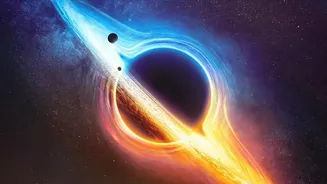
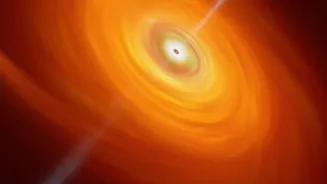
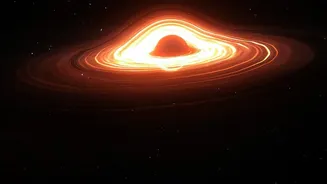
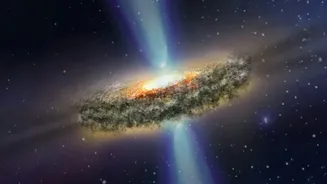
At the heart of most large galaxies, including our own Milky Way, lies a supermassive black hole. Most of the time, they are quiet. But when gas and dust fall into them, the material heats up and shines incredibly brightly across the entire electromagnetic spectrum. This turns the black hole into an Active Galactic Nucleus, or AGN. These AGNs are so luminous they can outshine all the stars in their host galaxy combined. However, in the turbulent environment of a galaxy merger, vast clouds of cosmic dust can obscure the view, making it difficult to detect the tell-tale light from these feeding black holes with traditional telescopes.
Webb’s Infrared Superpower
This is where the James Webb Space Telescope (JWST) changes the game. Unlike telescopes that see primarily in visible light, like Hubble, Webb is designed to detect infrared light. Infrared radiation has longer wavelengths that can pass through the dense clouds of cosmic dust that would otherwise block the view. Using its powerful Near Infrared Spectrometer (NIRSpec), astronomers didn't see the black holes directly. Instead, they detected the distinct signature of extremely hot hydrogen gas swirling at high velocities around three separate points within J0148-4214, confirming the presence of three actively accreting, or feeding, black holes.
A Trio of Cosmic Monsters
The discovery in J0148-4214 is the first evidence of three active black holes in a single galaxy in the distant universe. Two of the black holes are located close together in the galaxy's center, separated by only about 620 light-years. One of these is a behemoth, weighing in at 80 million times the mass of our sun, while its companion is a comparatively smaller 600,000 solar masses. A third black hole, with a mass of about 2 million suns, is located further out. This configuration suggests a multi-galaxy merger is underway, providing a real-world laboratory for how these cosmic giants grow.
Rewriting the Rules of Growth
This finding helps solve a long-standing puzzle: how did supermassive black holes get so big, so fast in the early universe? While they can grow by slowly consuming gas, this process takes time. The discovery of this black hole trio suggests that galactic mergers are a crucial and efficient pathway. When galaxies collide, their central black holes are brought together, eventually merging themselves and growing rapidly. The system in J0148-4214 is a preview of this process. The two central black holes are on a collision course and are expected to merge within a few hundred million years. This provides a powerful confirmation that mergers were a key driver of black hole growth in the young cosmos, setting the stage for the even larger mergers that future gravitational-wave observatories might detect.