


The Birth of a Precarious Lake
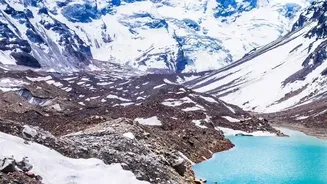
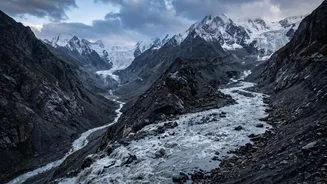
The story often begins with a process that seems slow and harmless: a melting glacier. As global temperatures rise, glaciers in the Himalayas are retreating at an accelerated pace. As they shrink, they leave behind depressions in the landscape that fill
with meltwater. These newly formed bodies of water, known as glacial lakes, are often held back by nothing more than unstable, natural dams made of loose rock and sediment left by the retreating glacier, called a moraine. These moraine dams are inherently fragile compared to concrete structures, creating a precarious situation high in the mountains.
The Sudden Trigger
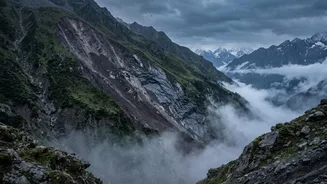
A stable glacial lake can exist for years, but its dam is a ticking time bomb. The trigger for disaster can be sudden and dramatic. A massive chunk of ice breaking off a glacier and crashing into the lake can cause a huge wave that overtops the dam. Similarly, a landslide or rockfall from the steep, unstable slopes surrounding the lake can displace a massive volume of water, causing the dam to fail. Other triggers include heavy rainfall that rapidly raises the lake's water level or even an earthquake that destabilizes the moraine dam. Once the dam is breached, the situation escalates instantly.
A Wall of Water and Debris
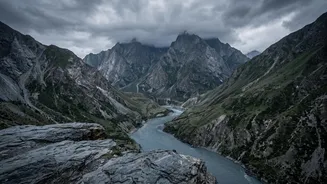
This is where a mountain hazard becomes a river hazard. The failure of the dam releases an enormous volume of water in a very short period—an event known as a Glacial Lake Outburst Flood (GLOF). This is not a simple flood. As the initial torrent of water rushes down steep mountain valleys, it gathers immense speed and power. It picks up everything in its path: sediment, boulders, uprooted trees, and ice. This mixture transforms the flood into a thick, fast-moving slurry, more like flowing concrete than water. This debris-laden flow has exceptional power to erode and destroy, carving deeper channels and growing in volume as it travels downstream, capable of wiping out bridges, roads, and entire villages in its path.
The Himalayan Hotspot
The Hindu Kush Himalaya region is particularly vulnerable to GLOFs, and India is on the front line. States like Sikkim, Uttarakhand, Himachal Pradesh, and Arunachal Pradesh have thousands of glacial lakes, with many identified as potentially dangerous. Past events serve as stark reminders of the threat. The 2013 Kedarnath tragedy was a compound disaster involving a glacial lake, and the 2023 GLOF from South Lhonak Lake in Sikkim caused widespread destruction and loss of life far downstream. Studies show that as glaciers continue to melt, the number and size of these lakes are increasing, elevating the risk for the millions of people who live in these mountain regions and the valleys below.
Racing Against the Clock
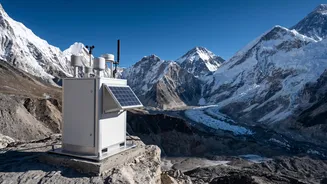
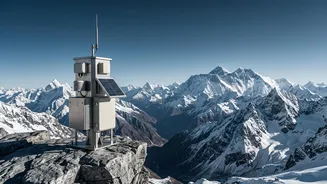
While the threat is significant, so are the efforts to manage it. Monitoring is the first line of defense. The National Disaster Management Authority (NDMA) and other agencies use a combination of satellite imagery and on-the-ground sensors to track the condition of high-risk lakes. In critical areas like Sikkim, early warning systems have been installed, with water-level sensors designed to transmit data in near real-time via satellite. These systems can run flood simulations and calculate how long a GLOF would take to reach downstream communities, providing vital, albeit limited, time for evacuation. The goal is to connect these technological solutions with local authorities and communities to ensure warnings reach the people most at risk.