



The Science of a Ticking Time Bomb
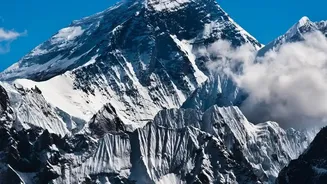
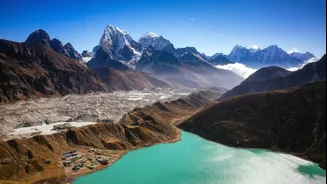
The story behind Nepal's flood risk isn't just about ice melting into water; it's about how and where that water collects. As glaciers retreat at an accelerating pace, they leave behind vast depressions that fill with meltwater, forming glacial lakes.
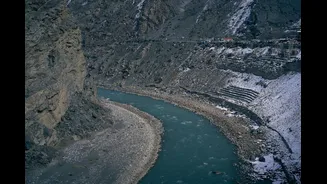
Many of these lakes are dammed by nothing more than unstable mounds of rock and sediment called moraines. These natural dams can fail suddenly, triggered by landslides, avalanches, or simply the immense pressure of the growing lake. The result is a Glacial Lake Outburst Flood (GLOF), a sudden and violent release of millions of cubic metres of water and debris that rushes down narrow mountain valleys with devastating force, wiping out everything in its path. A March 2026 report from the International Centre for Integrated Mountain Development (ICIMOD) confirmed that ice loss rates in the Hindu Kush Himalaya have doubled since the year 2000, creating more of these dangerous lakes.
Nepal: Ground Zero for Glacial Floods
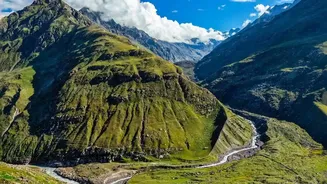
Nepal's unique geography, with steep slopes and deep river valleys, places it at the epicentre of this crisis. Recent events have provided devastating proof of this vulnerability. In late August 2026, a catastrophic flood in the Rasuwa district, triggered by a massive ice-rock avalanche near the Tibet border, destroyed homes, bridges, and critical infrastructure. This wasn't an isolated incident. The region is dotted with thousands of glacial lakes, and studies have identified dozens as being at high risk of a GLOF. A joint report by ICIMOD and the UNDP identified 47 potentially dangerous glacial lakes across Nepal, Tibet, and India, with 21 of them located within Nepal itself. For the countless communities, hydropower projects, and infrastructure built along these river valleys, the risk is existential. Even as the government undertakes projects to lower water levels in some high-risk lakes, scientists warn these efforts may not be enough to secure the downstream settlements.
A Regional Crisis, Not a Local Problem
While Nepal is on the immediate front line, the instability of Himalayan glaciers is a threat that looms over the entire region, including India. The glaciers of the Hindu Kush Himalaya feed ten of Asia's largest river systems, supplying water to nearly two billion people. The basins of the Indus, Ganges, and Brahmaputra, all vital to India, are particularly vulnerable. The 2026 disaster in Nepal has served as a stark warning for Indian Himalayan states. Following the event, the Indian government ordered a review of its own preparedness, acknowledging the presence of hundreds of potentially unstable glaciers within its borders. The disaster in Sikkim in October 2023, when the South Lhonak glacial lake breached and caused a devastating flood down the Teesta valley, had already highlighted that this is a shared regional vulnerability. The challenge is that these disasters often cross borders; a glacial collapse in Tibet can lead to a flood in Nepal, and a GLOF in Sikkim can have impacts downstream.
Beyond the Ice: The Human Cost and the Race Against Time
The true story of the unstable glaciers is ultimately a human one. It's about the families who have lost their homes and livelihoods, the communities living in constant fear, and the economies dependent on glacier-fed rivers for water, agriculture, and hydropower. The rapid and unpredictable nature of these events often means early warning systems are insufficient, with floods moving faster than alerts can be sent. In response, Nepal and its partners are working to improve monitoring, update early warning systems, and invest in disaster preparedness. Efforts include building protective infrastructure and, in some cases, draining high-risk lakes. However, there are significant gaps. Many glacierised regions remain poorly monitored, meaning we are often trying to navigate a rapidly changing future with an incomplete map. Scientists stress that engineering solutions alone cannot stop the glaciers from melting; they are a response to a crisis driven by global climate change.