







A Near-Perfect Climb to Orbit
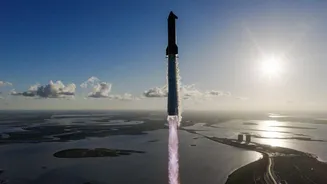
On Monday, the world's largest and most powerful rocket, Starship, successfully launched from SpaceX's Starbase facility in Texas. This 14th test flight was the first designed to achieve a full orbit around the Earth. The massive Super Heavy booster,
with its 33 Raptor engines, pushed the Starship upper stage towards space before separating and executing a planned soft splashdown in the Gulf of Mexico. The Starship stage then ignited its own engines, successfully completing an orbital insertion burn that pushed it to an altitude of about 275 kilometres (170 miles) and a blistering speed of over 26,000 kilometres per hour. For the first time, the giant spacecraft was officially in orbit, a milestone that prompted cheers at SpaceX mission control.
The 'But': An In-Flight Anomaly
The journey, however, was not without drama. During the ascent, one of the six engines on the Starship upper stage shut down earlier than planned. While the remaining engines compensated to ensure the craft still reached its target orbit, the anomaly introduced a new element of risk. After a tense period of assessment, flight controllers made the call to press on with orbital insertion. However, the original mission plan — a nearly 10-hour flight involving six trips around the globe — was scrapped. Citing an abundance of caution due to the engine issue, SpaceX opted to shorten the mission significantly. Instead of a long-duration flight, Starship would be brought back to Earth after just a few hours.
A Fiery But Successful Return
The revised plan called for a controlled deorbit and splashdown in the Pacific Ocean north of Hawaii. Starship successfully executed a deorbit burn, re-entered Earth's atmosphere, and withstood the immense heat and pressure of its descent. Onboard cameras streamed incredible images of glowing plasma wrapping around the vehicle's control flaps as it streaked through the sky. In the final moments, the ship re-ignited its engines, performed a complex flip maneuver to orient itself vertically, and achieved a controlled splashdown right on target. While the vehicle tipped over and broke apart upon hitting the water, as expected for an ocean landing, the entire sequence from orbit to splashdown was a resounding success, demonstrating the vehicle’s ability to survive a full mission cycle.
Why This 'Imperfect' Flight Is a Huge Win
For SpaceX, test flights are about gathering data, and by that measure, this mission was a treasure trove. It proved the fundamental viability of the launch system by achieving orbit. Crucially, it was also the first operational mission for Starship. The rocket successfully deployed 26 next-generation Starlink satellites into orbit, a task its smaller Falcon 9 rocket cannot perform. This marks the beginning of Starship’s role as SpaceX’s primary workhorse for building out its massive satellite internet constellation and generating revenue. This philosophy of 'testing to the limit' and learning from anomalies, even if it means not everything goes perfectly, is central to how the company rapidly innovates.
The Road to the Moon and Mars
This single flight has massive implications for the future of space travel. NASA is heavily invested in Starship's success, having selected it as the vehicle that will land its Artemis astronauts on the Moon, with missions planned for as early as 2028. Proving the rocket can reach orbit and return safely is a critical step on that path. Beyond lunar missions, the ultimate goal for Starship remains the colonization of Mars. Each successful test, even one with hiccups, brings that ambitious vision closer to reality. This flight demonstrated that despite minor engine issues, the system is robust and capable, paving the way for even more ambitious tests, such as in-orbit refueling and eventually catching the booster and ship for rapid reuse.