

A Tale of a Lost Companion
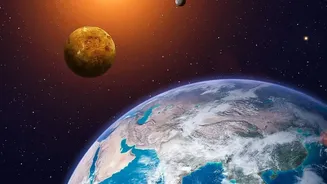
For years, the leading theories for Venus’s lonely status were that it either never formed a moon in the first place, or that a later, catastrophic impact destroyed it. But research published in The Astrophysical Journal proposes a new, more intimate
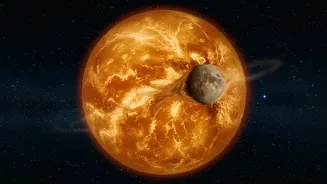
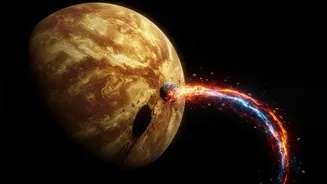
kind of destruction. According to astrophysicist Stephen Kane and his colleagues at the University of California, Riverside, the culprit may not have been an external event, but Venus itself. Using computer simulations, they modelled the relationship between Venus and a hypothetical moon. The results consistently pointed to a grim fate: the planet’s gravity, combined with its unique rotation, would have caused the moon to spiral inwards until it collided with and was absorbed by Venus.
The Slowest Spin in the Solar System
The key to this cosmic drama is Venus's incredibly slow rotation. A day on Venus lasts for 243 Earth days, which is longer than its year. This is vastly different from Earth’s brisk 24-hour spin. The rotation of a planet has a profound effect on its satellites due to tidal forces—the same forces that cause oceans' tides on Earth. A planet’s rotation transfers energy to its moon. On Earth, our relatively fast spin gives our Moon an energetic push, causing it to slowly drift away from us at a rate of about four centimetres per year. This was famously confirmed by mirrors left on the lunar surface during the Apollo missions. On a slow-spinning planet like Venus, however, that energy transfer works in reverse. Instead of pushing the moon away, the planet’s sluggish gravity would have relentlessly pulled it closer.
A Gravitational Tug-of-War
The simulations run by Kane’s team showed that the fate of a Venusian moon would depend heavily on the planet’s initial rotation speed. If early Venus had a day shorter than about 12 hours, a moon could have survived and migrated outward, much like our own. But if its spin was slower than this critical threshold, any moon that formed would have found itself in a losing battle. The model predicts that the tidal forces would cause the moon's orbit to decay, pulling it into a death spiral. Eventually, it would have reached the 'Roche limit', the point at which the planet’s gravity becomes so overwhelming that it tears the smaller body apart. The moon would have been shredded into a brief ring of debris that would then rain down and merge with the planet’s surface.
Searching for a Ghost Moon
While the simulations provide a compelling story, they don't prove Venus ever had a moon. Finding direct physical evidence is incredibly difficult. Venus underwent a massive volcanic resurfacing event about a billion years ago, which likely erased any craters or geological signs of a cataclysmic moon impact. However, scientists believe clues might still exist. Some have suggested that the impact could have left behind chemical traces in the atmosphere or unusual structures deep beneath the planet's surface. Future missions designed to study Venus's geology and atmosphere, like NASA's planned DAVINCI mission, could potentially search for these tell-tale signs of a long-lost companion.
What This Means for Other Worlds
This theory does more than just solve a local mystery; it has implications for our search for life elsewhere in the universe. Scientists hunting for 'Earth-like' exoplanets often see the presence of a large moon as a key factor for planetary stability and potential habitability. Earth's moon, for example, stabilises our axial tilt, which gives us predictable seasons. The Venus simulations suggest that simply being able to form a moon doesn't guarantee a planet can keep it. For a rocky planet to retain its satellite, it needs to rotate fast enough. This adds another crucial variable for astronomers to consider when identifying potentially habitable worlds, reminding us that the history of a planet can be just as important as its current location.