

The 'Evening Star' Takes Centre Stage
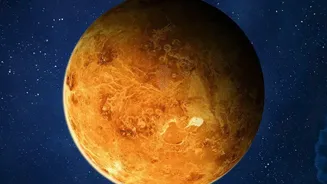
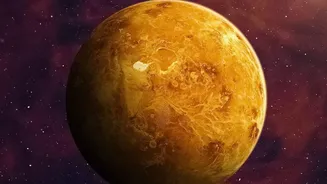
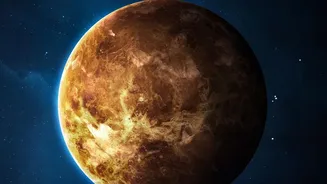
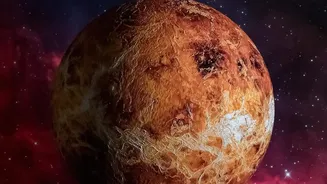
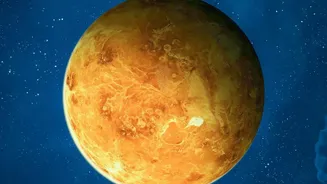
Anyone with a clear view to the west after sunset has likely noticed a brilliant, unwavering light hanging in the twilight. This is the planet Venus, often called the 'Evening Star'. Throughout 2026, it has been gradually climbing away from the Sun's
glare, becoming more prominent. On August 15, 2026, this journey culminates in a moment astronomers call 'greatest elongation east'. This is not a rare event, happening roughly every 19 months, but it marks the best time to view the planet in the evening sky. It’s a perfect opportunity for sky-gazers to appreciate our planetary neighbour without needing any special equipment.
What is Greatest Elongation?
Because Venus orbits the Sun closer than Earth does, it is always seen near the Sun from our perspective. This is why we only ever see it as a 'morning star' before sunrise or an 'evening star' after sunset; it can never be seen in the middle of the night. 'Elongation' is the term for the angle between the Sun and a planet as we see it from Earth. 'Greatest elongation' is simply the moment when Venus appears at its farthest distance from the Sun on the sky's dome. On August 15, 2026, Venus will be a full 46 degrees away from the Sun, making it visible for a longer period after the Sun has set and before it, too, dips below the horizon.
A Wide Angle but a Low Altitude
The headline's mention of Venus being 'low in the western evening sky' might seem confusing. If it’s the farthest from the Sun it can get, shouldn't it be high in the sky? This is where another celestial mechanic comes into play: the ecliptic. The ecliptic is the apparent path the Sun, Moon, and planets trace across our sky. This path is tilted relative to Earth's equator. During late summer evenings in the Northern Hemisphere, the ecliptic makes a shallow, low angle with the western horizon. So, even though Venus is at its maximum 46-degree angle away from the Sun along this path, the entire path itself is positioned low in the sky. This means Venus will be brilliantly bright but won't climb very high before setting.
How to See Venus in India
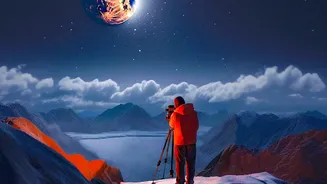
Spotting Venus is incredibly easy. It is the third-brightest object in the sky, after the Sun and the Moon, so you can't miss it. Starting from early August, simply look towards the western sky shortly after sunset. Venus will be the first 'star' to appear, a powerful point of light that doesn't twinkle like actual stars. On the evenings of August 14 and 15, the view will be extra special as a very thin waxing crescent moon will be visible near the dazzling planet, creating a beautiful pairing in the twilight. For the best view, find a location with an unobstructed western horizon, away from tall buildings or trees, and give your eyes a few minutes to adjust to the fading light.
What's Next for Venus?
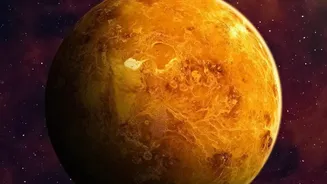
While greatest elongation on August 15 marks its farthest separation from the Sun, Venus will actually reach its peak brightness in late September. During the weeks following its elongation, Venus will start to sink back towards the Sun's glare each evening. As it does, its distance to Earth decreases. If you have a pair of binoculars or a small telescope, you can observe its phase changing. At greatest elongation, it appears about 50% illuminated, like a tiny half-moon. In the weeks that follow, it will transform into a larger, thinner crescent before eventually disappearing into the sunset glare in October on its way to inferior conjunction, when it passes between Earth and the Sun.