


The Mystery of the Little Red Dots
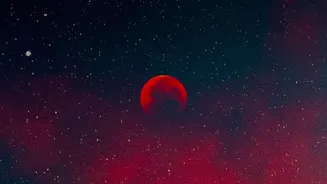
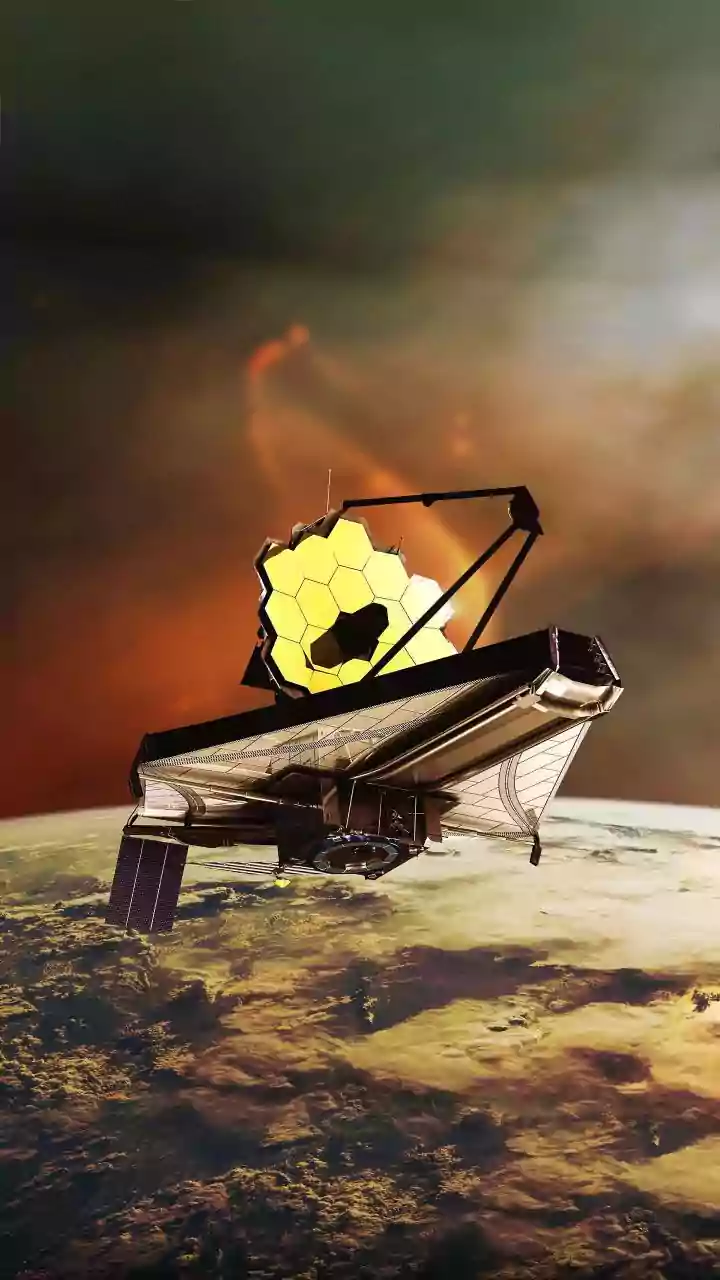
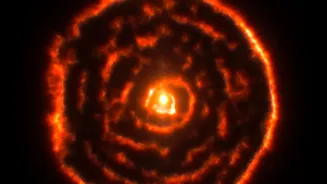
Since it began operations, the JWST has been delivering breathtaking images of the early universe. Within these cosmic portraits, astronomers have consistently found strange, compact, and intensely bright red objects. Dubbed 'little red dots,' these sources
date back to just a few hundred million years after the Big Bang. Their brightness is a major puzzle; they appear far too luminous to be individual stars or even the young galaxies expected in that era. Another confusing aspect is their colour. While redness in space often points to thick clouds of cosmic dust, the light signature from these objects doesn't quite match. This has left scientists debating what these enigmatic dots truly are.
Introducing the 'Black Hole Star'
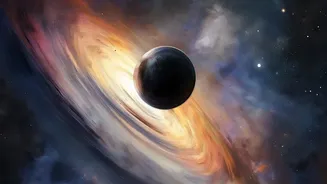
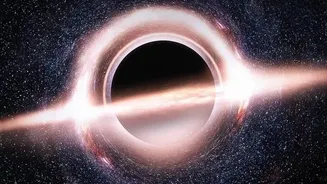
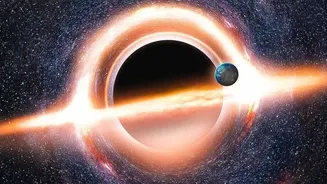
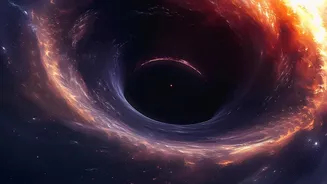
To solve this puzzle, a team of astronomers has proposed a radical new idea: a completely new type of celestial object they call a 'black hole star', also known by the theoretical name 'quasi-star'. The theory, detailed in a recent study, suggests these objects are not stars in the traditional sense, nor are they typical black holes. Instead, they are a hybrid. The concept posits a massive black hole at the core, but instead of being surrounded by a flat, spinning disc of matter, it is enveloped in an enormous, dense cocoon of hydrogen gas. This gas cloud would be so thick that it would glow intensely, looking like a gigantic star from the outside.
How to Build a Cosmic Hybrid
A normal star, like our Sun, generates energy through nuclear fusion in its core. A black hole star would operate very differently. The energy source wouldn't be fusion, but the immense power generated by material falling into the central black hole. In this model, the intense radiation pressure pushing outwards from the feeding black hole would perfectly balance the immense gravitational pull of the surrounding gas cloud, creating a stable, albeit temporary, object. Scientists believe these could form from the collapse of a gigantic protostar in the early universe, where the core collapses into a black hole but the outer layers are massive enough to remain bound, absorbing the energy burst. One particular candidate, named MoM-BH*-1, is estimated to have a central black hole about 100,000 times the mass of our sun, surrounded by a gas envelope the size of our solar system.
Solving the Red and Bright Puzzle
This black hole star model elegantly explains the two most confusing properties of the little red dots: their brightness and their colour. The extreme luminosity, which could be 100 billion times that of a normal star, would come from the supermassive black hole furiously consuming matter at its centre. The characteristic red colour, meanwhile, wouldn't be caused by dust. Instead, researchers suggest it's the result of having an incredibly dense screen of hydrogen gas. This dense gas would scatter light in a way that makes the object appear red, much like how smoke particles can make the sun appear red. The team's simulations showed that such an object would look just like the little red dots observed by JWST.
A New Origin Story for Giants
If confirmed, the existence of black hole stars could solve another major cosmic headache: how supermassive black holes grew so large, so quickly in the early universe. Current models struggle to explain how black holes could reach millions or billions of times the mass of the Sun in less than a billion years. Black hole stars could be the missing link. They would serve as a 'seed' phase, allowing black holes to gain immense mass rapidly while being cloaked in a gas envelope. Eventually, after millions of years, the black hole would consume its gaseous cocoon and emerge as the type of supermassive black hole we see at the centre of galaxies today. This makes every little red dot a potential snapshot of a galactic giant in its infancy.