


A Galactic Slowdown
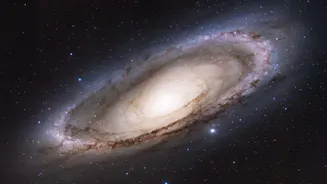
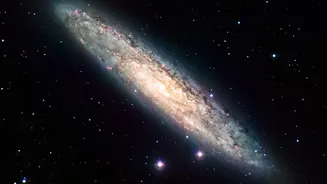
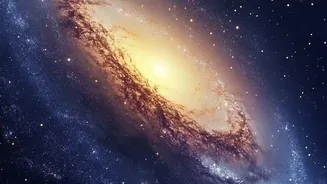
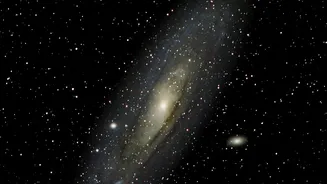
Astronomers have found that star formation in the Andromeda galaxy has been in a steady decline for the last half-billion years, with a particularly sharp drop in the last 40 million. About 500 million years ago, Andromeda was creating stars at a rate
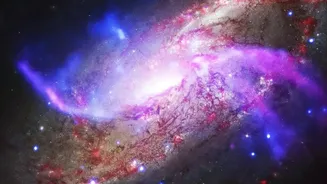
of roughly one Sun's mass per year. Today, that rate has plummeted to about one-fifth of a solar mass annually. This discovery offers a detailed look into the life cycle of a spiral galaxy, suggesting Andromeda is transitioning from a vibrant, active galaxy into a more quiescent, or retired, state. The slowdown appears to be a natural winding-down process following a major burst of star formation that occurred about two billion years ago, likely caused by an interaction with another galaxy.
Reading the Stellar Fossil Record
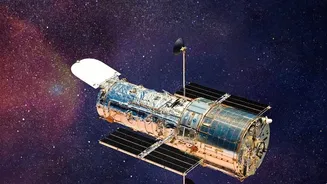
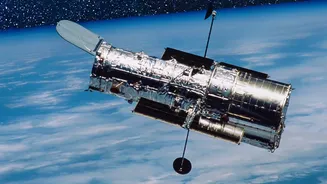
To uncover this history, scientists acted like cosmic archaeologists. Using the incredible resolution of the Hubble Space Telescope, they analyzed roughly 200 million individual stars across a huge portion of Andromeda's disk. Stars serve as a 'fossil record' for a galaxy. Massive stars burn hot, appear blue, and have very short lives, while smaller, less massive stars are redder and live much longer. By mapping the colors of stars in different regions, astronomers can build a timeline of when and where star birth was most active. Regions rich in blue stars indicate recent star formation, whereas redder areas point to an older population of stars. This method allowed the team to create an unprecedentedly detailed history of Andromeda's recent evolution.
The Search for a Cause
The slowdown isn't happening uniformly. Much of Andromeda's remaining star formation is concentrated in a dusty ring about 32,000 light-years from its center, and it's the fading of activity in this ring that is driving much of the overall decline. Interestingly, researchers believe the galaxy isn't running out of the necessary raw material—cool gas and dust—to make new stars. Instead, the decline seems to be a natural settling period. One potential culprit that might be contributing to the slowdown is Andromeda’s small satellite galaxy, M32. Studies show a noticeable drop in star formation in the area near M32, suggesting a past interaction around 60 million years ago might have disrupted stellar nurseries in that region, creating a 'dead zone'.
A Glimpse into Our Own Future?
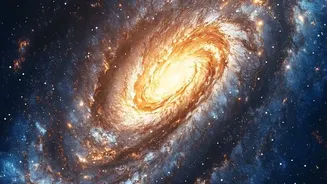
As the closest large spiral galaxy, Andromeda serves as an ideal laboratory for understanding galaxies like our own. The Milky Way is also a spiral galaxy, and studying Andromeda's transition into 'middle age' provides clues about our own eventual fate. While the Milky Way currently has a higher star formation rate than Andromeda, our galactic neighbor's history of dramatic starbursts and subsequent slowdowns could foreshadow the long-term evolutionary path that awaits us. Understanding why Andromeda's stellar nurseries are dimming helps astronomers refine their models of how all massive galaxies evolve, age, and eventually run out of steam.
A Collision Course
Looking much further into the future, Andromeda and the Milky Way are on an inevitable collision course. Gravitationally bound, the two galaxies are hurtling toward each other at about 110 kilometers per second and are predicted to merge in approximately 4.5 billion years. This colossal event will not involve stars crashing into each other, as the space between them is vast. Instead, the two galaxies will merge over billions of years, their stars thrown into new orbits to form a new, giant elliptical galaxy, sometimes nicknamed 'Milkomeda'. While Andromeda’s current star formation is weak, the compression of gas clouds during the merger could trigger a new, powerful burst of star creation, briefly reigniting the stellar fires before they ultimately settle down.