








Two Worlds, One Sky
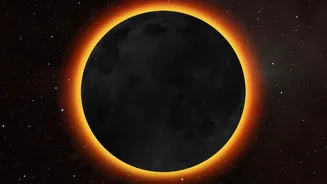
On August 12, 2026, a total solar eclipse will chart its path across the globe. While it won't be directly visible from India, occurring late at night, the country will still be watching. Millions will tune into livestreams from NASA and other global
observatories, their screens filled with the fiery corona of the sun. Social media feeds will buzz with hashtags, scientific explanations, and stunning images captured from Spain and Iceland. This is the online eclipse boom—a global, digital, and collective viewing experience. Yet, in millions of Indian households, the response will be starkly different. Windows may be shuttered, kitchens will go quiet, and families will gather not for viewing parties, but for prayers and ritual fasting. This isn’t a rejection of science, but the powerful pull of a tradition that sees an eclipse not just as a celestial alignment, but as an event of profound spiritual significance.
The Legend of the Demon and the Nectar
The traditional caution surrounding eclipses, known as 'grahan', is deeply embedded in Hindu mythology. The most enduring story is that of the 'Samudra Manthan' or the churning of the cosmic ocean to produce 'amrita', the nectar of immortality. According to the legend, a demon named Svarbhanu disguised himself as a god to steal a sip of the precious liquid. The sun (Surya) and moon (Chandra) spotted the imposter and alerted Lord Vishnu, who swiftly decapitated the demon with his Sudarshana Chakra. However, since the nectar had already touched the demon's throat, both parts became immortal. The head, known as Rahu, and the body, known as Ketu, became shadow planets. In an act of eternal revenge, Rahu and Ketu are said to periodically swallow the sun and moon, causing eclipses. This mythological event frames the eclipse as an inauspicious time, when the life-giving luminaries are under attack, temporarily weakening their positive influence on Earth.
Rituals of Caution and Purification
This mythological narrative gives rise to a host of traditional practices observed during a grahan. It is widely advised to avoid cooking and eating during the eclipse, as the absence of sunlight is believed to increase harmful microorganisms. To protect leftover food, blades of Tulsi (holy basil) are often placed in dishes and water containers. Many temples close their doors, believing the idols are vulnerable to the negative energies. Pregnant women are especially advised to take precautions, staying indoors and avoiding sharp objects to protect the unborn child from supposed ill effects. While scientists have found no evidence to support these specific fears, the traditions persist as powerful cultural practices. The period is seen as an opportune time for spiritual activities like chanting mantras, meditation, and prayer, which are believed to have multiplied benefits. After the eclipse passes, a ritual bath is often taken to cleanse oneself of any residual negative influences.
The Digital Viewing Party
In stark contrast, the internet has turned the eclipse into a participatory global spectacle. For those in India, where the 2026 eclipse is not visible, online access is the only way to witness it. Space agencies like NASA and the European Space Agency (ESA) provide high-definition, multi-location livestreams with expert commentary, drawing tens of millions of viewers worldwide. Indian science communicators and institutions also play a vital role, organizing online events and using social media to explain the science behind the phenomenon and debunk myths. These digital platforms have cultivated a new kind of eclipse experience—one focused on education, shared wonder, and a sense of global community. The internet buzzes not with warnings, but with tips on photography, explanations of orbital mechanics, and a collective sense of awe that transcends geographical boundaries.
A Modern Indian Synthesis
The most interesting part of this story isn't a simple clash between science and superstition. Instead, what is emerging is a uniquely Indian synthesis. Many younger Indians find themselves navigating both worlds. They will share the NASA livestream link in a family WhatsApp group while also reminding their pregnant sister to stay indoors. They might watch the celestial event unfold on their laptop and then join their parents for a purifying bath once it’s over. This hybrid approach reflects a broader trend in modern India, where tradition and modernity are not mutually exclusive but are often woven together. The online eclipse boom hasn't erased ancient beliefs; it has simply added another layer to how Indians experience these cosmic moments. The screen offers a window to the scientific marvel, while tradition offers a framework for spiritual reflection.