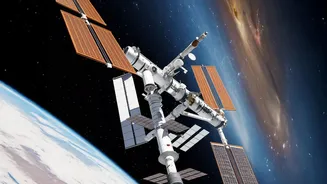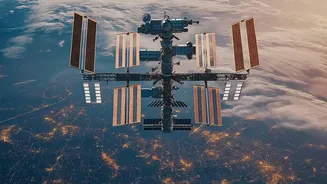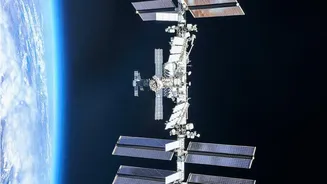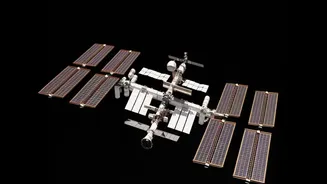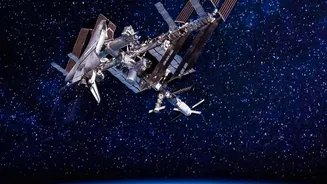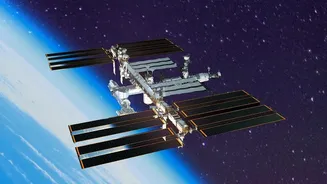



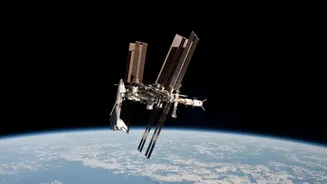
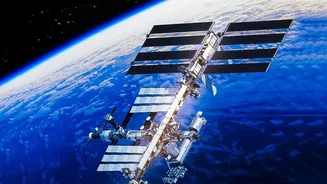

The International Space Station just received a major boost. After a multi-year effort involving complex spacewalks, NASA has completed an ambitious upgrade, increasing the orbiting laboratory's power-generating capacity by up to 30 percent.
A Five-Year Power Overhaul
The International
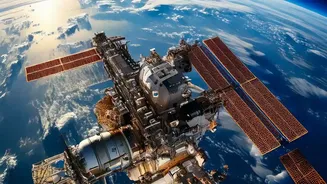
Space Station (ISS) has been continuously inhabited since November 2000, serving as a premier laboratory for microgravity research. However, its original solar arrays, designed for a 15-year lifespan, have naturally degraded over two decades of harsh exposure to the space environment. To counteract this power loss and prepare the station for its final decade of operations, NASA initiated a comprehensive upgrade program. This five-year project, which began in June 2021 and concluded in November 2026, involved installing eight new, more advanced solar arrays to augment the station's existing power grid. The final installation was completed by NASA astronaut Anil Menon and Canadian Space Agency astronaut Joshua Kutryk during a nearly seven-hour spacewalk.
How the New Arrays Work
The new hardware is called the ISS Roll-Out Solar Array, or iROSA. These arrays feature a novel design that allows them to be rolled into a compact cylinder for transport and then unfurled like a measuring tape once in space, without the need for complex motors. This makes them lighter and more compact than the station's original rigid arrays. Instead of replacing the old arrays, a complex and risky task, the new iROSAs were strategically installed over a portion of the original ones. This setup allows the new, more efficient arrays to work in tandem with the legacy system, boosting total power generation from about 160 kilowatts to a combined 215 kilowatts. The arrays were manufactured by Redwire under contract with Boeing.
More Power, More Science
The 30 percent power increase is more than just a simple top-up; it is a critical enabler for the station's future. This additional electricity will support a growing number of complex scientific experiments that require higher energy inputs, from materials science to combustion studies. It also helps power the station's life support systems and daily operations for an expanded crew. Crucially, the enhanced power grid will support the attachment and operation of new commercial modules, such as those being developed by Axiom Space. These modules are expected to form the basis of a future commercial space station after the ISS is retired, ensuring a continued human presence in low-Earth orbit.
The Challenge of Installation
Upgrading the power system of a football field sized object moving at 28,000 kilometres per hour is no simple task. The installation of the eight iROSA units required a series of meticulously planned spacewalks by multiple astronaut crews over several years. The arrays were delivered to the station in pairs inside the unpressurized trunk of SpaceX Dragon cargo capsules. Once they arrived, astronauts, often assisted by the Canadarm2 robotic arm, would venture outside the station for hours at a time to mount the new hardware and connect sensitive power cables. The final installation in November 2026 was particularly challenging, requiring the spacewalkers to hand off the 340 kilogram array to each other to move it to the far end of the station's main truss, beyond the reach of the robotic arm.
Powering the Next Decade in Space
This successful upgrade ensures the ISS can continue to operate as a worldclass scientific outpost through its planned retirement in 2030. The technology pioneered with the iROSA system is already being used in other ambitious space missions. It powered NASA's DART mission, which successfully tested a method for planetary defence, and is planned for use on the Lunar Gateway, an outpost that will orbit the Moon and support future Artemis missions. By revitalizing the space station, NASA and its international partners have not only extended the life of a remarkable piece of engineering but have also invested in the technologies that will power the next generation of space exploration.