




A Trio of Cosmic Couples
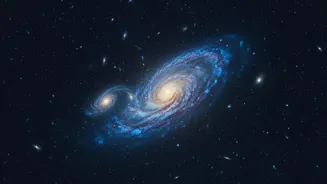
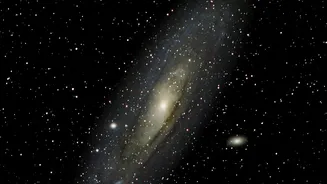
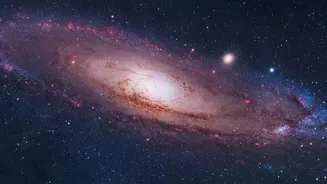
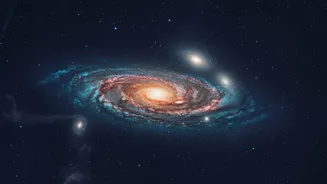
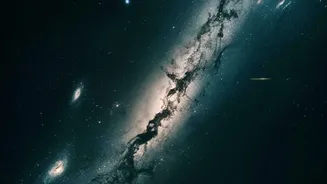
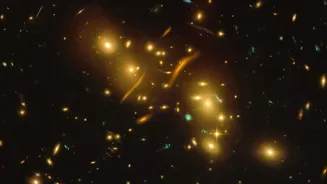
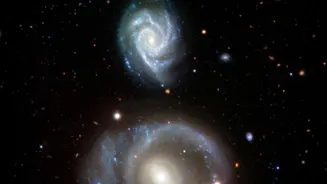
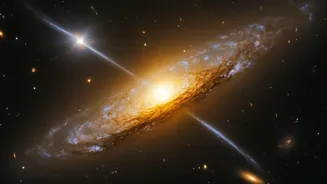
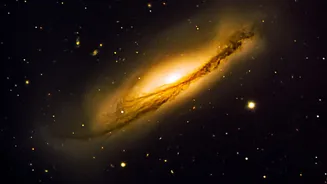
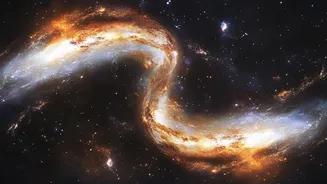
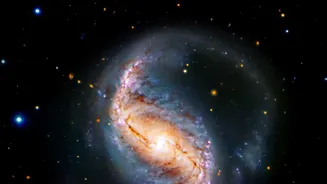
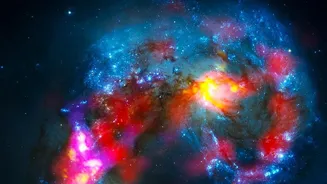
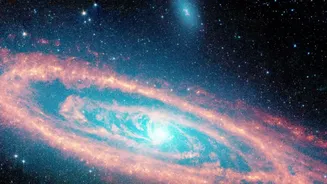
At first glance, the image is a stunning celestial portrait of cosmic companionship. It showcases three distinct pairs of galaxies, each duo seemingly locked in a gravitational dance. Spread across a dark expanse, these galactic couples capture the imagination.
Near the top, a striking galaxy with a blue stripe sits near a companion. In the middle, two more galaxies appear close enough to touch. At the bottom, a third pair seems to be in the active process of merging, their structures distorted by mutual gravitational pulls. The image presents a tidy, compelling narrative of galactic interaction, a story told in three acts. But in astronomy, as on Earth, appearances can be profoundly misleading.
Unraveling a Visual Deception
This is where the idea of a 'misleading perspective' comes into play. NASA astronomers have explained that not all these pairs are what they seem. The two galaxies at the bottom of the image are indeed interacting. In perhaps a billion years, NGC 4622A and NGC 4622B will likely merge into a single, larger galaxy. However, the other pairs are a cosmic illusion. The two galaxies in the middle, despite appearing close, are not thought to be gravitationally bound; their relative speeds suggest it is a chance alignment from our viewpoint on Earth. Similarly, the top two galaxies are likely not interacting at present. What we are seeing is a trick of perspective, where the immense, three-dimensional depth of space is flattened into a single, two-dimensional image.
The Science of Seeing in Deep Space
This phenomenon is a common challenge for astronomers. When we look into space, we are looking across unfathomable distances. Galaxies that appear side-by-side might be separated by millions of light-years, one far behind the other along our line of sight. It’s like seeing a plane in the sky appear close to the Moon; we know they are at vastly different distances, but from our perspective, they can momentarily align. To sort fact from fiction, astronomers use a variety of sophisticated techniques. They can’t just rely on a single image to understand the true relationship between cosmic objects.
Decoding the Universe's True Distances
So, how do scientists tell if two galaxies are true partners or just passing strangers? One of the most powerful tools is measuring 'redshift'. As the universe expands, light from distant objects gets stretched, shifting its color towards the red end of the spectrum. By measuring the specific redshift of a galaxy, astronomers can calculate how fast it is moving away from us and, by extension, its approximate distance. If two adjacent galaxies have vastly different redshifts, it's a clear sign that they are not neighbors at all. Other methods, like using certain types of supernovae as 'standard candles' with known brightness, also help build a reliable 'cosmic distance ladder' to map the universe accurately.
Why Getting Perspective Right Matters
Distinguishing between a chance alignment and a genuine interaction is crucial for understanding how the universe works. True galactic collisions and mergers are fundamental drivers of cosmic evolution. These events can trigger massive bursts of star formation, reshape galaxies, and feed the supermassive black holes at their centers. Accurately identifying these interactions helps scientists refine their models of galaxy growth and the large-scale structure of the cosmos. An image of a seemingly interacting pair might be a beautiful illusion, but an image of a truly interacting pair is a snapshot of creation in progress, as seen with the bottom pair in this very image. Each confirmation adds another piece to the puzzle of our cosmic history.