






You may never fly over the dunes and methane lakes of Saturn’s largest moon, but your name can. NASA is inviting the public to be part of a historic journey, sending their names nearly a billion miles from Earth on the Dragonfly mission to Titan.
A Message in a Bottle to the Stars
In a
modern twist on sending a message in a bottle, NASA has opened a public campaign called 'Journey to Titan'. This initiative allows people from around the world to have their names etched onto a microchip that will be placed aboard the Dragonfly spacecraft. The program offers a personal connection to one of the most ambitious planetary science missions ever conceived. After submitting their name, participants receive a commemorative digital boarding pass for the trip. The deadline for submissions is January 15, 2027, giving space enthusiasts ample time to secure their symbolic seat on this incredible voyage. This follows a tradition of public engagement for NASA, which has previously sent millions of names to Mars on the Perseverance rover and to Jupiter's moon Europa aboard the Europa Clipper.
What is the Dragonfly Mission?
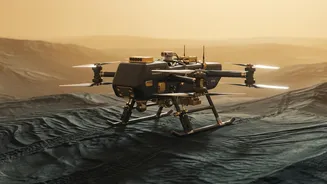
Scheduled for launch in July 2028, Dragonfly is a revolutionary mission unlike any other. Instead of a wheeled rover, NASA is sending a car-sized, nuclear-powered rotorcraft—essentially a drone—to explore Titan. This eight-bladed vehicle is designed to take advantage of Titan's unique environment. The moon has an atmosphere that is four times denser than Earth's and low gravity, making it an ideal place for aerial exploration. Upon its arrival in 2034, Dragonfly will be the first powered and fully controlled aircraft to fly on another world's moon. Its mission is planned to last about 3.3 years, during which it will fly from one scientifically interesting site to another, covering miles in a single trip—a feat impossible for a ground-based rover.
Exploring the Alien World of Titan
Titan is one of the most intriguing bodies in our solar system. It is the only moon known to have a dense, planet-like atmosphere, and the only place besides Earth with stable bodies of liquid on its surface. But this isn't a world of water. On Titan, where surface temperatures hover around a frigid -179 degrees Celsius, rivers, lakes, and seas are filled with liquid methane and ethane. Water ice is as hard as rock and forms the bedrock of the landscape. A thick, golden haze of nitrogen and methane shrouds the moon, obscuring its surface, which features vast fields of organic sand dunes and a weather cycle that mirrors Earth's water cycle, but with methane. Scientists also have strong evidence that a vast ocean of liquid water exists beneath Titan's icy crust.
The Search for Life's Building Blocks
Dragonfly’s primary goal is not to find life itself, but to search for the chemical building blocks of it. Scientists believe the conditions on Titan today resemble those of early Earth before life emerged. The mission will study prebiotic chemistry—the complex organic compounds that could be ingredients for life. Dragonfly is equipped with a suite of instruments, including a mass spectrometer to analyze chemical compositions and a drill to collect samples from the surface. The rotorcraft will explore diverse locations, from dunes to the floor of an impact crater named Selk, to understand how far prebiotic chemistry has progressed in an environment that is both alien and strangely familiar. By studying Titan, scientists hope to gain insights into the origins of life on our own planet.