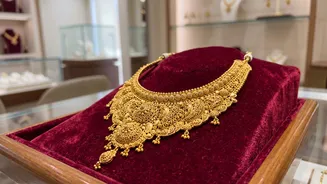









As Dhanteras 2026 arrives, many are eyeing gold, especially after a much-talked-about price correction. But the rate on the news ticker rarely matches the final bill. Let's break down what you're actually paying for.
Understanding the 'Spot Price'
The price you see on financial news
channels or online trackers is the 'spot price'. This is the wholesale rate for pure, 24-karat gold traded in large volumes on global commodity markets. Think of it as the raw material cost, quoted per troy ounce (about 31.1 grams) and before any India-specific costs like import duties, taxes, or jeweller margins are added. It's the baseline from which all retail prices are derived, but it's not a price any customer can pay for a single chain or coin.
The First Layer: Purity and Jeweller's Rate
Most gold jewellery in India is made from 22-karat gold, which is 91.6% pure gold mixed with alloys for durability. Jewellers adjust the 24-karat spot price to calculate the rate for 22-karat gold. On top of this, they add their own premium to cover import duties, transportation, and other business overheads. This creates the 'board rate' you see displayed in a showroom, which is already higher than the spot price.
The Biggest Add-On: Making Charges
This is often the most significant and variable cost added to your bill. Making charges cover the labour and artistry required to transform raw gold into a piece of jewellery. These can be calculated as a percentage of the gold's value (ranging from 8% to over 25%) or as a flat fee per gram. Intricate, handcrafted designs will have much higher making charges than simple, machine-made items, which explains why two pieces with the same weight can have vastly different final prices.
The Final Bill: GST and Hallmarking
The Goods and Services Tax (GST) is another key component. A 3% GST is applied to the value of the gold. In addition, a separate 5% GST is typically levied on the making charges. While some jewellers might present a single 3% GST on the total value for simplicity, the underlying structure involves taxing both the metal and the service of making it. Finally, a small, fixed fee for hallmarking, which certifies the gold's purity via a 6ndigit Hallmark Unique Identification (HUID) number, is also added to the invoice.
The 'Price Correction' Reality
Gold prices hit a record high in January 2026 before seeing a significant correction of over 20% in the following months. As of early November, just before Dhanteras, prices had recovered slightly but remained well below their peak, up about 7% -8% compared to last year's festival. However, a dip in the spot price doesn't always lead to an immediate or equivalent drop in retail jewellery prices. Jewellers often hold inventory bought at older, higher rates, and these costs are passed on to the consumer. Therefore, while a correction makes gold more attractive, the full benefit might not be reflected in your bill instantly.