


The Standard Black Hole Playbook
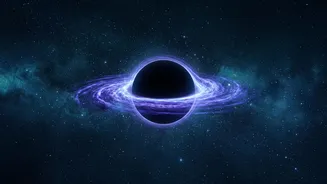
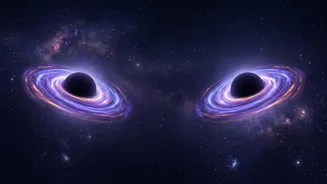
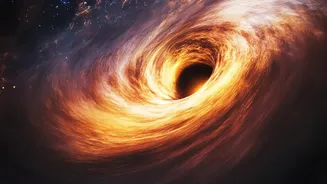
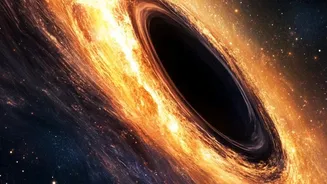
Our current understanding of black holes generally sorts them into two main categories based on how they form. The most common are stellar-mass black holes, which are typically a few to 100 times the mass of our sun. These are the violent leftovers of massive
stars that, after exhausting their nuclear fuel, collapse under their own gravity in a spectacular supernova explosion. On the other end of the scale are the supermassive black holes, behemoths that are millions or even billions of times our sun's mass and reside at the centers of most large galaxies, including our own Milky Way. Scientists believe they grow to such immense sizes by devouring stars, gas, and even by merging with other black holes over cosmic history. For decades, this two-pronged origin story has served as the foundation of black hole astronomy.
Cosmic Puzzles and Mass Gaps
Despite the prevailing theories, astronomers have been puzzled by certain observations that don't quite fit. For instance, the James Webb Space Telescope has found supermassive black holes in the very early universe that seem 'too big, too soon', having grown faster than models allow. Furthermore, observations from gravitational wave detectors like LIGO have pointed to so-called 'mass gaps'. One gap exists between the heaviest neutron stars and the lightest black holes. Another theorized gap, known as the 'pair-instability gap', suggests that stars of a certain massive size should explode so violently they leave nothing behind, meaning no black holes should exist in a range roughly between 60 and 130 solar masses. Yet, detections of black hole mergers have included objects that fall squarely within this 'forbidden' zone, forcing scientists to question their formation models.
Enter the Primordial Black Hole
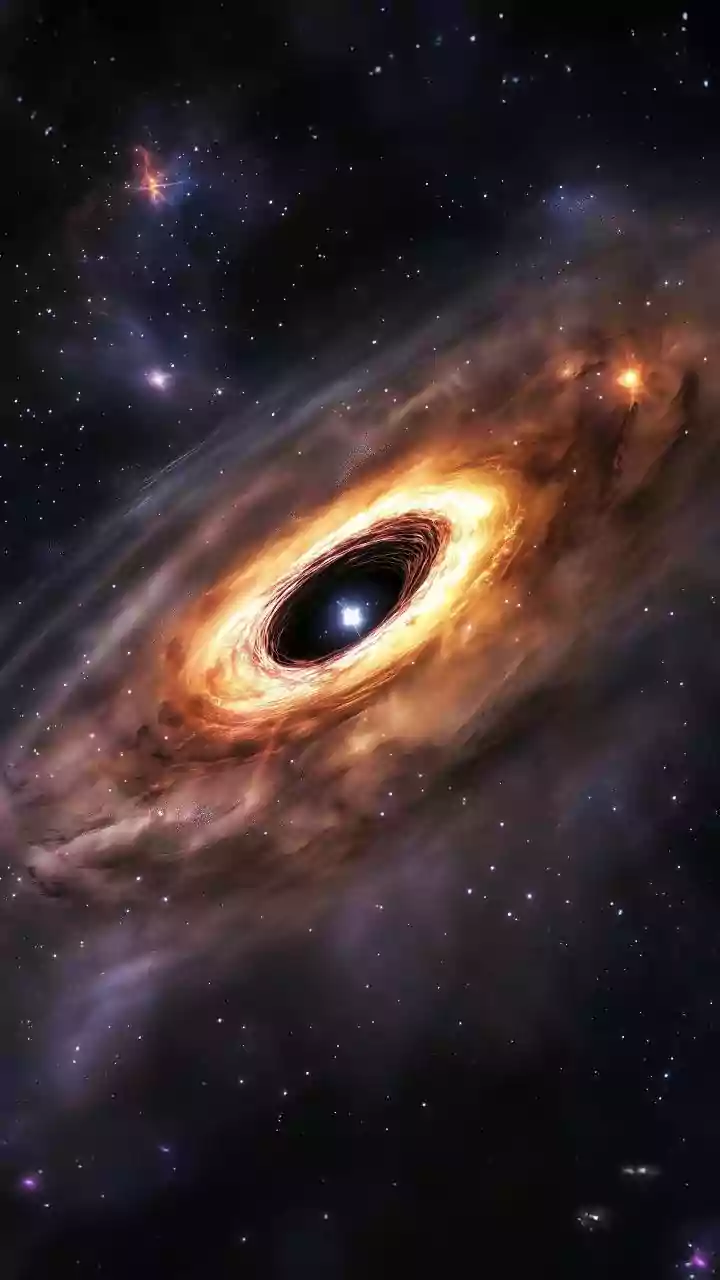
This is where a fascinating, decades-old idea comes back into focus: primordial black holes (PBHs). First proposed in the 1960s and 70s, the theory suggests that not all black holes needed a parent star. In the incredibly dense and chaotic environment moments after the Big Bang, tiny fluctuations in density could have been so extreme that pockets of matter collapsed directly into black holes. Unlike their stellar cousins, these primordial black holes could have formed with a vast range of masses, from smaller than an atom to many thousands of times the mass of the sun. This separate origin story provides a potential solution to some of the universe's biggest puzzles.
A Candidate for Dark Matter
The possibility of primordial black holes is especially exciting because it could solve one of the greatest mysteries in all of science: the nature of dark matter. This invisible substance makes up about 85% of the matter in the universe, and its gravitational pull is what holds galaxies together. Scientists have been searching for the particles that make up dark matter for decades with no success. But what if dark matter isn't a new type of particle at all? What if it's composed of ancient, non-stellar black holes drifting through the cosmos? Recent studies and unusual gravitational wave signals, which lack conventional explanations, have renewed hope that PBHs could be the answer, potentially accounting for a significant portion, if not all, of the universe's missing mass.
The Hunt for Ancient Echoes
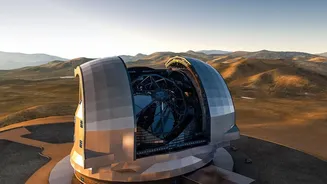
Confirming that smaller black holes have a primordial origin is now a major focus for astronomers. The evidence could come from several directions. One is through gravitational waves. An unusual signal detected by LIGO, for instance, pointed to a merger involving an object less massive than our sun—too small to have been formed by a collapsing star, making it a strong candidate for a PBH. Future, more sensitive observatories will be able to better discriminate between the gravitational wave signatures of primordial and astrophysical black hole mergers. Another clue could come from observing how these smaller black holes behave differently. One new theory even explores whether small primordial black holes might be more prone to splitting apart, a process not expected with larger ones. Each new detection brings us closer to understanding if these smaller black holes are truly a separate class of cosmic object, born in the fire of the Big Bang.