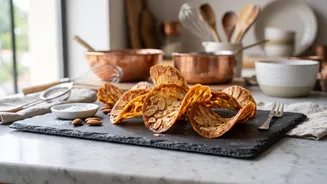



Elegant, paper-thin, and irresistibly crisp, French almond tuiles seem like a delicacy reserved for fancy patisseries. But these sophisticated cookies are surprisingly simple to create at home with just a handful of pantry staples.
What Are French Tuiles?
A tuile (pronounced
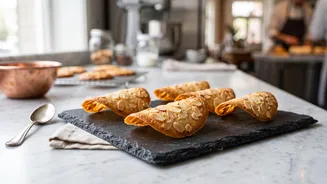
'tweel') is a classic French wafer, so named because its signature curved shape resembles the terra-cotta roof tiles seen across the French countryside. The magic of a tuile lies in its texture: it’s incredibly thin, light, and shatters with a satisfying crispness. While traditionally served alongside coffee, ice cream, or creamy desserts like mousse, these almond-flavoured biscuits are a delight on their own. Their delicate, nutty flavour and elegant appearance can elevate a simple afternoon tea into a special occasion, proving that impressive French baking doesn't have to be intimidating.
The Simple Ingredient Foundation
The beauty of the almond tuile lies in its simplicity. You only need a few core ingredients to create the batter. The classic recipe calls for egg whites, sugar, all-purpose flour, and melted butter. For this almond version, slivered or flaked almonds are folded into the batter, lending a rich, nutty aroma and a beautiful, lacy appearance to the finished cookie. A drop of vanilla or almond extract can be added to enhance the flavour. The key to the perfect texture is the ratio of these ingredients; the high sugar and fat content is what creates the delicate, crisp final product. No special equipment is needed, just a bowl, a whisk, and a baking sheet.
The Method to Delicacy
Creating tuiles is more about technique than complex steps. The process begins by whisking egg whites until foamy, then incorporating sugar, flour, and finally, melted butter and almonds to form a smooth, thin batter. Some recipes recommend chilling the batter for about 30 minutes to make it easier to work with. Once ready, you drop small spoonfuls onto a parchment-lined baking sheet, leaving ample space between them. Using the back of a spoon or an offset spatula, spread the batter into very thin circles, about three inches in diameter. The thinner you spread it, the more delicate and crisp your tuile will be. Bake for just a few minutes until the edges are golden brown; the centre will still be pale.
Mastering the Signature Curve
The most crucial step in making tuiles is shaping them, and it must be done quickly. The cookies are only pliable while they are hot, straight out of the oven. Because of this, it's best to work in small batches of four to six cookies at a time. As soon as you remove the baking sheet from the oven, use a thin spatula to carefully lift one cookie and drape it over a rolling pin, a clean wine bottle, or even the handle of a wooden spoon. Gently press it to create the curve, holding it for just a few seconds until it sets. As they cool, they will harden into their iconic tile shape. If your cookies cool too quickly and become brittle, you can return them to the warm oven for a minute to make them pliable again.
A Perfect Pairing with Fresh Berries
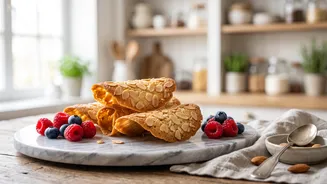
The nutty, caramelized flavour of almond tuiles finds its perfect counterpoint in the bright, juicy sweetness of fresh berries. The pairing is a wonderful study in contrasting textures and tastes. The tartness of raspberries and strawberries cuts through the buttery richness of the cookie beautifully. Blueberries, with their subtle sweetness and wine_like complexity, also offer a fantastic complement. For an effortlessly elegant dessert, serve a platter of warm almond tuiles alongside a simple bowl of mixed berries. You can also crumble the cookies over a scoop of ice cream topped with a fresh berry sauce. In India, consider pairing them with seasonal mulberries (shahtoot) for a local twist; their jammy, earthy notes work wonderfully with the toasted almond flavour.