

The Unseen Threat From Our Sun
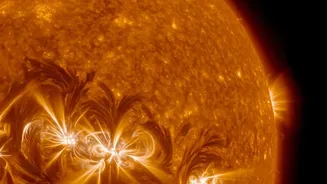
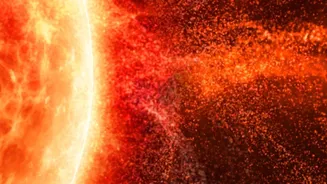
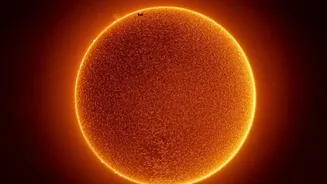
Our star constantly breathes out a stream of charged particles known as the solar wind. Most of the time, this is a gentle breeze that our planet’s magnetic field easily deflects. But sometimes, the Sun unleashes violent eruptions called Coronal Mass
Ejections (CMEs). These are colossal clouds of plasma and magnetic fields that race through space. If one of these storms hits Earth, it can trigger a geomagnetic storm, overwhelming our natural defences. The consequences can be severe: crippled power grids leading to widespread blackouts, damaged satellites disrupting communications and GPS navigation, and increased radiation risks for astronauts and even passengers on high-altitude flights. In an age where everything from banking to emergency services relies on this technology, such a storm is a major threat to modern society.
IMAP: Our New Eye on the Sun
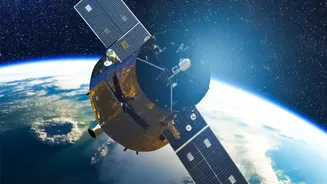
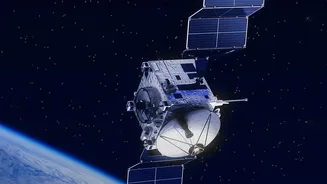
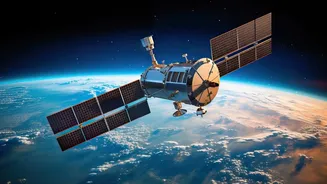
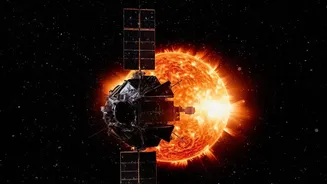
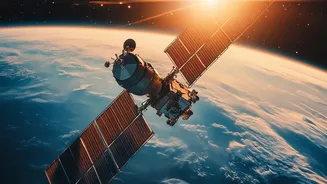
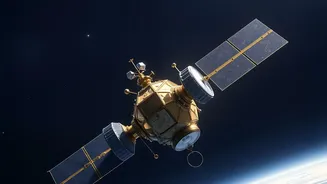
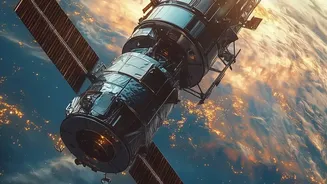
Enter the Interstellar Mapping and Acceleration Probe, or IMAP. Launched in September 2025, this advanced NASA mission has a dual purpose. Its primary job is to act as a state-of-the-art space weather station. Strategically positioned 1.5 million kilometres from Earth at a stable gravitational point called Lagrange Point 1 (L1), IMAP has an uninterrupted view of the Sun. From this upstream vantage point, it directly samples the solar wind particles and magnetic fields flowing towards us. But IMAP is also a celestial explorer. It's designed to map the boundaries of our solar system, a protective bubble called the heliosphere, which is inflated by the solar wind and shields us from harsh galactic radiation. By studying how the solar wind interacts with the vast expanse of interstellar space, IMAP seeks to answer fundamental questions about our place in the galaxy.
The 'Near-Real-Time' Game Changer
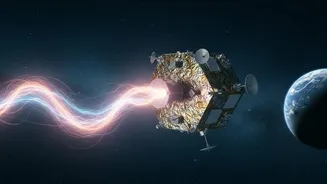
The key question for space weather forecasters has always been about time. How can we get a faster, more reliable warning? This is where IMAP's near-real-time data comes in. The spacecraft is equipped with a system called I-ALiRT (IMAP Active Link for Real-Time), which continuously broadcasts critical measurements from its instruments back to Earth. Because IMAP is positioned so far 'upstream', this data gives forecasters about a 30 to 60-minute head start before a solar disturbance reaches our planet. This might not sound like much, but in the world of space weather, it's a crucial window. It allows power grid operators to take protective measures, satellite operators to put their spacecraft into safe mode, and airlines to reroute flights away from polar regions where radiation effects are strongest. This advance warning system is a significant upgrade, providing a constant stream of high-quality data to improve prediction models.
A Deeper Scientific Quest
Beyond its role as a watchdog, IMAP's suite of ten advanced instruments is on a mission of discovery. Scientists want to understand the very engine of space weather: how particles are accelerated by the Sun to form the solar wind. Instruments like the Solar Wind Electron (SWE) experiment provide 3D maps of these particles, offering new insights into their behaviour. IMAP also studies 'energetic neutral atoms' (ENAs), special particles that travel in straight lines from the edge of the solar system, unaffected by magnetic fields. By tracing these messengers, scientists can create the first comprehensive maps of the heliosphere's boundary, a region that would otherwise be invisible. This helps us understand how our solar system is shielded from dangerous cosmic rays, a key factor that makes life on Earth possible.