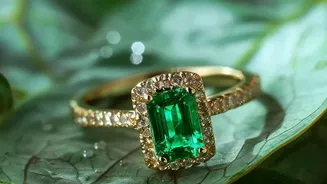








A Treasure Born of Legend
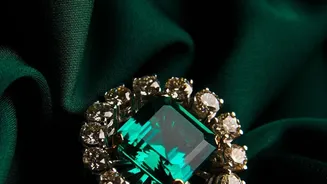
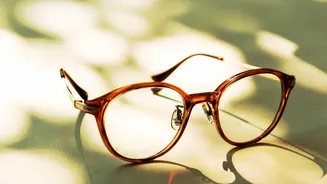
The spectacles, known as the ‘Gate of Paradise’ or ‘Astaneh-ye-Ferdaws’, are an object of myth and mastery. Their story begins with a single, magnificent raw emerald, believed to be of Colombian origin and weighing an estimated 300 carats. Finding a stone
of such size and quality was itself a near-impossible feat. Colombian emeralds were highly prized by the Mughal emperors, who established strong trade routes to acquire the finest specimens for their legendary treasury. The commission for these lenses would have come from the highest echelons of the empire, possibly even the emperor himself, during a period of immense wealth and artistic flourishing under rulers like Shah Jahan.
The Art of an Impossible Cut
Transforming a rough, crystalline stone into two delicate, matching lenses was a task of breathtaking difficulty. Emeralds are notoriously brittle and prone to internal fractures, making them a lapidary's nightmare. The unknown artisan who undertook this challenge had to first envision how to cleave the 300-carat giant into two viable pieces. They then had to grind and polish them into perfectly curved, transparent teardrop shapes, each measuring about 26 millimetres in length. This process would have been done entirely by hand, with immense material loss—the final lenses weigh a combined total of around 27 carats. The willingness to sacrifice so much of a precious stone for this unique creation speaks to the patron's singular vision and the craftsman's supreme confidence.
More Than Meets the Eye
These lenses were never intended to correct vision. Instead, their purpose was likely spiritual and symbolic. In Islamic tradition, the colour green is deeply associated with paradise, healing, and salvation. It is believed that looking through these emerald filters was considered an aid to spiritual enlightenment, a way to literally see the world through a divine lens. One persistent legend connects the spectacles to Emperor Shah Jahan, who is said to have used emeralds to soothe his eyes after weeping for days following the death of his beloved wife, Mumtaz Mahal. While this story remains unconfirmed, it highlights the stone's long-held association with healing powers.
A Companion in Diamond
The 'Gate of Paradise' was not alone. A second, equally astonishing pair of spectacles was created, known as the ‘Halo of Light’ ('Halqeh-ye-Nur'). Its lenses were fashioned from a single, flawless diamond believed to originate from the famed Golconda mines of India and weighing over 200 carats. Like the emeralds, the diamond lenses were also seen as a tool for illumination and connecting with the divine. The two pairs, one of emerald and one of diamond, represent the pinnacle of Mughal lapidary art and the fusion of immense wealth with mystical belief. For centuries, they remained together, a matched set of unparalleled wonders.
A Modern Reappearance
For much of their existence, the emerald lenses were likely held in a simpler setting or even handled directly. The ornate, diamond-studded frames we see today are a later addition, crafted around 1890 to suit the fashions of the time. After disappearing from public view for generations, the 'Gate of Paradise' and 'Halo of Light' spectacles surfaced in 2021, causing a sensation in the art world. They were offered for auction by Sotheby's, carrying estimates of millions of dollars each and allowing the world a rare glimpse into the ingenuity and extravagance of the Mughal court.