





A Specialist in a Sky Full of Giants
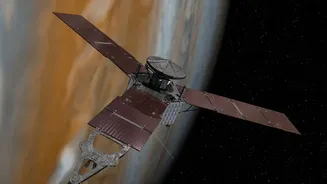
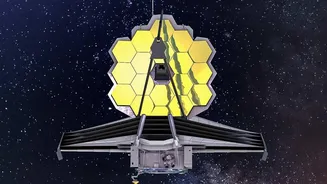
In an era of massive space observatories like the James Webb Space Telescope (JWST), NASA’s Pandora mission is a reminder that size isn’t everything. Pandora is a SmallSat, a compact and cost-effective satellite designed for a highly specialized task.
Launched in January 2026, it is the first mission under NASA's Astrophysics Pioneers program, which champions smaller, faster, and more focused scientific projects. Its primary mission, lasting one year, is to study the atmospheres of at least 20 known exoplanets to figure out what they are made of, with a particular focus on identifying water, clouds, and hazes. Unlike its larger cousins that observe a vast array of cosmic phenomena, Pandora has a single, crucial goal: to solve a vexing problem that complicates our study of distant worlds.
The Star-Spot Problem
Scientists study exoplanet atmospheres using the "transit method.” When a planet passes in front of its host star, a tiny fraction of the starlight filters through the planet's atmosphere. By analyzing that light, astronomers can detect the chemical fingerprints of molecules like water. But there's a catch: stars are not perfect, static balls of light. They have active surfaces with features like starspots (similar to our Sun's sunspots) and brighter regions called faculae. These features can change a star's brightness and light spectrum as it rotates. This "stellar contamination" can distort the data, making it difficult to tell if a signal is coming from the planet's atmosphere or the star itself. A changing starspot could mimic the signature of water, or hide it entirely, leading to inaccurate conclusions about a planet's composition.
Seeing Clearly with Two Kinds of Light
Pandora's clever solution is to watch the star and the planet simultaneously in two different types of light. The spacecraft is equipped with an 18-inch (45-centimeter) telescope that splits the incoming light. One instrument, a photometer, tracks the star's brightness in visible light. This allows scientists to monitor the changes caused by starspots rotating into and out of view. At the same time, a near-infrared spectrograph analyzes the light that passes through the planet's atmosphere during a transit. By comparing the data from both instruments, astronomers can effectively subtract the 'noise' from the star, leaving behind a much cleaner signal from the planet's atmosphere. This technique is crucial for confirming the presence of key molecules like water.
A Curated List of Worlds
The mission will focus on at least 20 carefully selected exoplanets, ranging in size from super-Earths to gas giants. These targets were chosen because they transit their stars frequently, providing numerous opportunities for observation during Pandora's year-long primary mission. For each of the 20-plus planets, Pandora will stare for an extended period, observing a minimum of 10 transits per target. This long-duration observation strategy is something that powerful, high-demand telescopes like JWST cannot typically afford to do. This dedicated, repetitive observation allows Pandora to build a robust dataset, mapping the variability of each star and providing the clean atmospheric data needed to determine if these worlds have hydrogen- or water-dominated atmospheres.
Paving the Way for Future Discovery
Pandora isn't designed to find new planets, but to make our understanding of known ones better. The data it collects will provide critical context for observations made by JWST and other major observatories. By solving the stellar contamination puzzle, Pandora helps lay a firmer foundation for the entire field of exoplanet atmospheric science. It acts as a scout and a fact-checker, refining our techniques and helping scientists decide which planets are the most promising candidates for deeper study in the ongoing search for habitable worlds. This small but mighty mission demonstrates how targeted, lower-cost projects can play an essential role in answering some of the biggest questions in science, complementing the work of their larger, more famous counterparts.