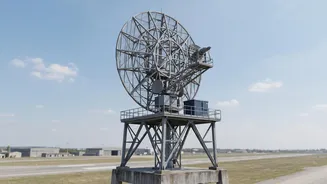





Thousands of flights cancelled, tens of thousands delayed, and travel plans for countless people thrown into chaos. The culprit wasn't a storm or a security threat, but a single piece of hardware: a network router in rural Arkansas.
A Cascade of Chaos
On Friday, November
13, the U.S. Federal Aviation Administration (FAA) took the drastic step of issuing a nationwide ground stop, halting all departing flights for nearly five hours. The decision was made after air traffic controllers at multiple high-altitude control centers began experiencing intermittent problems with communications and radar feeds. The result was immediate and widespread disruption. Over the course of the weekend, more than 18,000 flights were cancelled and over 27,000 were delayed, leaving passengers stranded at airports across the country. Airlines scrambled to manage the fallout, working to reposition aircraft and crews long after the initial problem was solved.
The Tiny Culprit in a Vast System
Investigators quickly traced the source of the problem to a newly installed router at an FAA radio facility in El Dorado, Arkansas. The router, installed by government contractor L3Harris Technologies as part of a system-wide upgrade from older copper wires to fiber optics, began to malfunction. It started flooding the FAA's network with an overwhelming amount of data—roughly 1,000 connection attempts every four to five seconds. This data deluge caused instability at 17 of the nation's 22 air traffic control centers, which are responsible for managing aircraft at high altitudes between airports. A similar issue was also identified with a router installed weeks earlier in Amarillo, Texas.
A Single Point of Failure
The incident serves as a stark reminder of how modern, interconnected systems can have a 'single point of failure'. A seemingly small, localized technical problem can create a massive blast radius, interrupting entire industries. The FAA's telecommunications network is a complex fabric that links radar, communications, and flight-data systems for thousands of controllers. When the Arkansas router began misbehaving, it didn't just fail locally; it destabilized the entire network it was connected to. This is why controllers couldn't simply switch to a backup system; the primary system itself was being actively compromised by a flood of junk data. While no evidence of a cyberattack was found, the event highlights a critical vulnerability in national infrastructure.
The Official Response and Fix
With communications stuttering, the FAA made the safety-first call to ground all takeoffs so that controllers could focus on the 3,500 planes already in the air. Technicians worked to trace the source of the data flood and, upon identifying the routers in Arkansas and Texas, blocked their traffic from the network. This allowed the system to stabilize, and the ground stop was lifted after about four and a half hours. In the aftermath, the FAA has paused the installation of any more new routers and disabled the problematic broadcasting feature on approximately 60 similar devices across the country as a precaution. The specific router from Arkansas is now being examined in a lab to determine if the fault was due to the device itself, an installation error, or a configuration mistake.
Preventing the Next Shutdown
This event has renewed intense scrutiny of the FAA's aging infrastructure, which officials have been warning about for years. Transportation Secretary Sean Duffy noted that the copper wire-based equipment will continue to experience failures and is using the incident to push for billions in congressional funding to accelerate modernization efforts. The goal is to move away from the current system, largely maintained by L3Harris, to a new network built by major telecom companies. While the upgrade to fiber-optic lines is intended to improve the system, this incident shows the risks involved in transitioning complex, legacy technology. Experts agree that resilience depends not just on preventing failure, but on building systems that can limit how far a single failure can travel.