





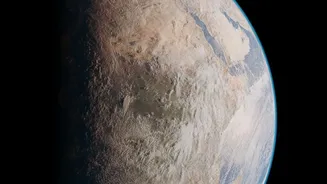
Meet the Super-Earth, LHS 1140 b
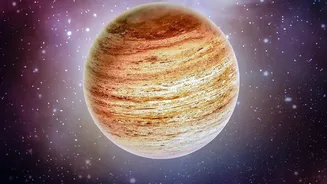
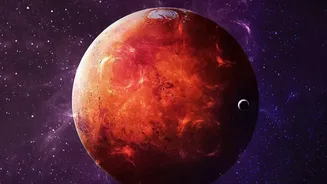
First discovered in 2017, LHS 1140 b is an exoplanet located about 49 light-years from Earth. It's classified as a 'super-Earth'—a world larger and more massive than our own, but still fundamentally rocky. Specifically, it has a radius about 1.7 times
that of Earth and packs about 5.6 times the mass. It orbits a red dwarf star, which is smaller and cooler than our sun. Crucially, LHS 1140 b orbits within its star's 'habitable zone'. This is the so-called 'Goldilocks' region where temperatures are just right to potentially allow liquid water to exist on a planet's surface, a key ingredient for life as we know it. Its equilibrium temperature is quite cold, but a thick atmosphere could create a greenhouse effect, making the surface much warmer.
The Breakthrough Detection of an Atmosphere
For years, confirming an atmosphere on a rocky, habitable-zone exoplanet has been a monumental challenge. But in a landmark discovery, astronomers have found the smoking gun. Using the Magellan Clay telescope in Chile, an international team detected helium gas escaping from LHS 1140 b. Helium, being a very light gas, tends to rise to the top of an atmosphere and slowly leak into space when energized by its star. Observing this faint signal of escaping helium is the first direct and convincing evidence that LHS 1140 b has retained a substantial atmosphere. This is a huge milestone; while we've found atmospheres on gas giants, finding one on a potentially habitable rocky world is a first.
A New Path for Finding Habitable Worlds
This discovery fundamentally changes the playbook for hunting for life-sustaining planets. The host star, LHS 1140, is a red dwarf—the most common type of star in our galaxy. These stars are notoriously volatile, especially in their youth, often blasting their nearby planets with intense radiation that was thought to strip away any chance of an atmosphere. Many scientists were skeptical that a planet orbiting so close to a red dwarf could hold onto its gaseous envelope. LHS 1140 b proves that it's possible. It has likely maintained its atmosphere for billions of years despite the harsh environment. This opens a 'new route' for study by showing that the vast number of planets orbiting red dwarfs are viable candidates for having atmospheres and, just maybe, life. It forces a major rethink of which worlds we should prioritise for closer study.
From 'Mini-Neptune' to 'Water World'
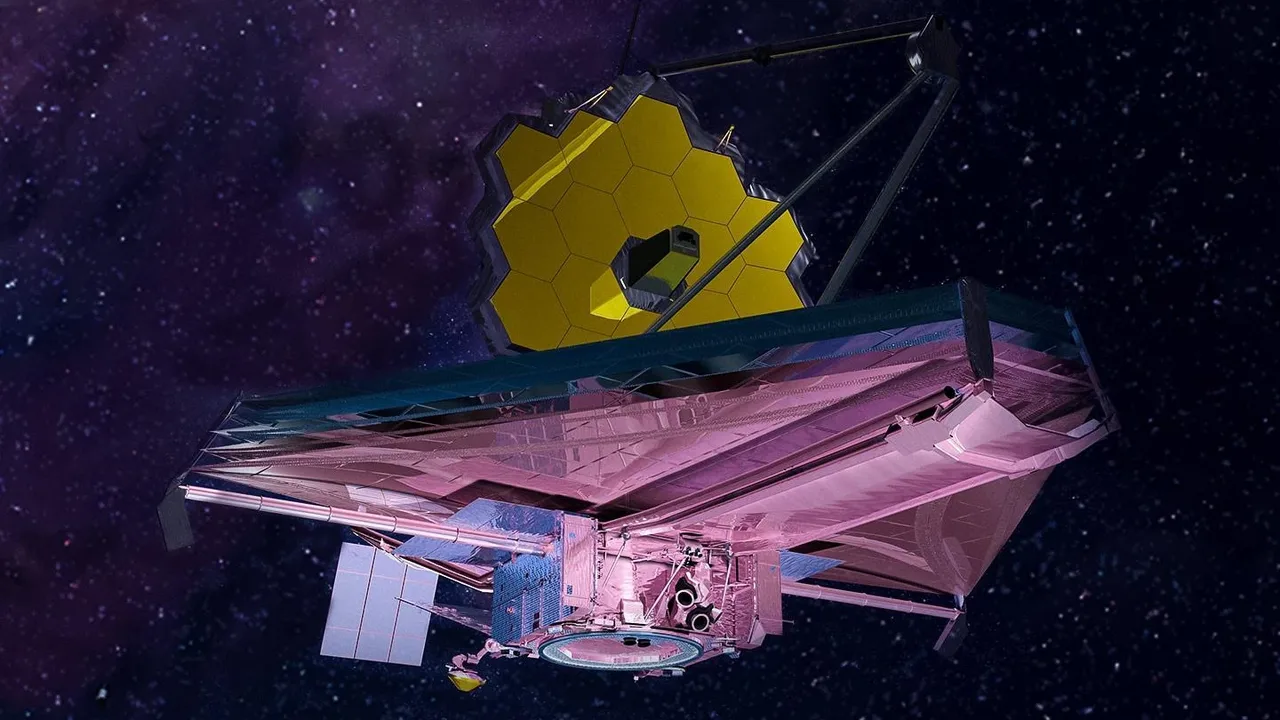
The nature of LHS 1140 b has been a subject of intense debate. Early data suggested it could be a dense rocky planet, but more precise measurements of its mass and radius pointed to a lower density. This led to two main theories: it was either a 'mini-Neptune' with a thick, hydrogen-rich atmosphere, or a 'water world' with a significant portion of its mass being water. Recent observations from the James Webb Space Telescope (JWST) have already ruled out the mini-Neptune scenario, finding no evidence of a puffy, hydrogen-dominated atmosphere. This latest discovery of a retained, heavier atmosphere bolsters the water world hypothesis. Scientists now theorize it could be an ice-covered planet with a liquid ocean beneath, or possibly a global ocean with a nitrogen-rich atmosphere.
What Comes Next for Our Cosmic Neighbor?
Confirming the existence of an atmosphere is just the beginning. The real work starts now. LHS 1140 b has immediately become one of the most important targets for the JWST. The detection of helium proves there is a gaseous envelope to study, and the next step is to find out what it's made of. Future observations will aim to detect heavier, more life-relevant molecules like water vapor, nitrogen, methane, and carbon dioxide. Finding these would provide an even clearer picture of the planet's climate and potential habitability. While the discovery is not evidence of life itself, it confirms that a world with the essential ingredients for life—a rocky surface, the right temperature, and a protective atmosphere—exists just a short cosmic distance away.