





The Problem of Earth’s Fiery Past
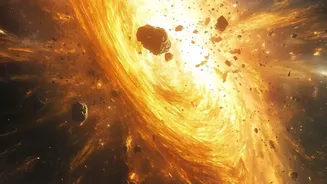
To understand why platinum is an extraterrestrial treasure, we must first travel back in time to our planet's formation, around 4.5 billion years ago. The early Earth was a turbulent, molten ball of rock and metal. In this fiery cauldron, heavier elements
naturally began to sink towards the planet's centre, while lighter elements floated towards the surface. This process, known as planetary differentiation, is what formed Earth’s distinct layers: the core, mantle, and crust. Iron, being dense and abundant, plunged deep to form the planet's core. And unfortunately for anyone hoping to find platinum easily, it has a strong chemical affinity for iron.
An ‘Iron-Loving’ Element
Platinum belongs to a group of elements called siderophiles, which literally means “iron-loving.” Because of this property, any platinum present during Earth's initial formation would have readily dissolved into the molten iron and been dragged down into the core along with it. Scientists estimate that more than 98% of Earth's original endowment of precious metals, including platinum and gold, is now locked away thousands of kilometres below our feet, completely inaccessible. So, if all the initial platinum sank to the core, why do we find any in the crust at all? The answer, it turns out, didn't come from Earth, but from the violent depths of space.
The Only Place Violent Enough to Make Platinum
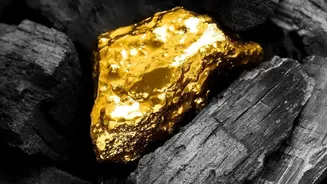
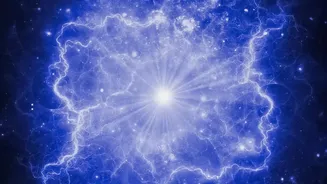
Stars are the universe's element factories, but even they have their limits. Through nuclear fusion, stars can create elements up to the weight of iron. Forging anything heavier, like platinum, requires an immense amount of energy and a massive flood of neutrons—a process called the rapid neutron capture process, or r-process. For decades, scientists suspected supernovae (the explosions of giant stars) might be responsible, but the numbers didn't quite add up to explain the abundance of heavy metals we see. The leading theory now points to an even more cataclysmic event: the collision of two neutron stars. These are the ultra-dense collapsed cores of massive stars, and when they merge, the resulting explosion, called a kilonova, is powerful enough to create vast quantities of the universe's heaviest elements, including platinum. In fact, a single neutron star merger can produce amounts of gold and platinum equivalent to the mass of several Earths.
A Special Delivery from the Cosmos
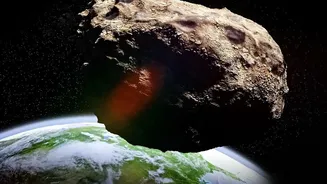
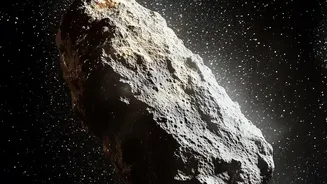
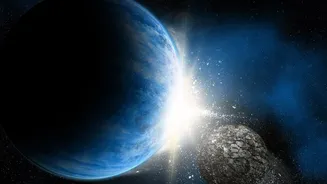
The platinum we find in jewellery and catalytic converters today arrived on Earth long after our planet had formed and its core had settled. For hundreds of millions of years, the young Earth was pummelled by asteroids and meteorites in an era known as the Late Heavy Bombardment. These cosmic projectiles, remnants from the formation of the solar system, were rich in the heavy elements forged in earlier stellar events like neutron star collisions. This celestial bombardment acted as a 'late veneer,' delivering a fresh dusting of platinum and other precious metals to Earth's crust and upper mantle. Because the planet had already cooled and differentiated, this new supply of platinum did not sink into the core and remained within our reach, albeit in the very low concentrations that make it so rare and valuable today.