


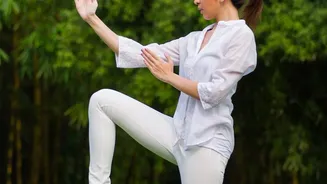
Tai Chi: Flexibility in Flowing Movement
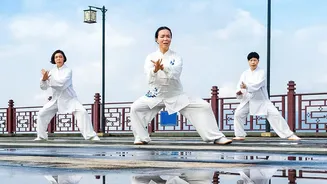
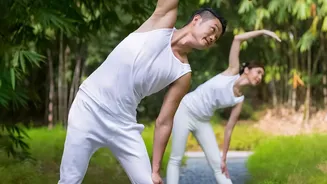
Tai Chi is often called 'meditation in motion', and this description perfectly captures its approach to flexibility. Instead of holding static stretches, Tai Chi develops what is known as active or dynamic flexibility through slow, deliberate, and flowing
movements. The practice guides your joints through their full, natural range of motion without force. As you shift your weight, rotate your torso, and extend your limbs, you are gently lengthening muscles and encouraging joint mobility. This is not about achieving an extreme range like a split, but rather about developing functional, controlled movement. The constant, gentle rotation and weight-shifting lubricate the joints in the hips, spine, shoulders, and ankles, gradually reducing stiffness and improving overall mobility. This makes it an exceptionally accessible practice for improving flexibility, especially for those with joint pain or limited mobility.
Kayaking: Flexibility for Power and Stability
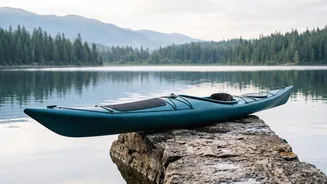
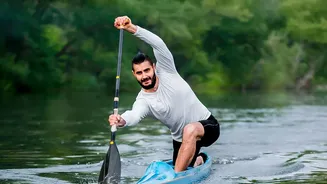
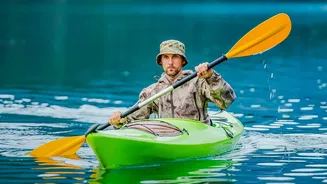
Flexibility in kayaking serves a very different purpose: it is the foundation for power, efficiency, and stability on the water. While beginners often think paddling is all about arm strength, efficient kayaking is powered by the large muscles of the core and back. This is only possible with good rotational flexibility in the torso. A powerful paddle stroke involves winding and unwinding the torso to transfer force, which requires a supple spine and mobile obliques. Beyond the core, kayaking demands flexibility in the hips, hamstrings, and lower back. Being seated for long periods requires limber hamstrings to maintain a tall, effective posture and avoid slouching, which can lead to back pain. Hip flexibility is also crucial, not just for comfort in the boat but for control, allowing a paddler to edge and brace the kayak effectively.
Lower Body and Core: A Tale of Two Needs
The way these two activities engage the lower body and core highlights their distinct flexibility demands. In Tai Chi, the focus is on creating a stable, rooted base from which to move. This requires strong, flexible legs and mobile hip joints to sink into stances and shift weight smoothly. The core is constantly engaged to maintain balance and facilitate the flow of movement through the body. Tai Chi builds functional flexibility from the ground up. Kayaking, conversely, requires the lower body to act as a brace. Your legs and glutes provide a solid foundation inside the kayak, anchoring your body so your core can rotate powerfully. This means that while strong legs are important, it is the flexibility of the hip flexors and hamstrings that is paramount for enabling a comfortable and powerful seated position. Without it, your pelvis tilts back, your spine rounds, and your ability to rotate your torso is severely compromised.
Upper Body and Spine: Openness vs. Rotation
In the upper body, Tai Chi promotes openness and relaxation. Movements like 'Cloud Hands' or 'White Crane Spreads its Wings' encourage relaxed, open shoulders and a mobile upper spine, releasing tension rather than building it. The goal is to move the arms as extensions of the body, led by the rotation of the torso. Kayaking demands a more athletic form of upper-body flexibility. Shoulder mobility is critical for reaching forward to place the paddle and completing a full stroke without injury. The real engine, however, is thoracic (upper and mid-back) spinal rotation. An efficient stroke comes from twisting the torso, engaging the powerful latissimus dorsi muscles in the back, which takes the strain off the smaller arm and shoulder muscles. This powerful rotation is what allows for endurance on longer paddles and prevents overuse injuries.
A Question of Progression
A key difference lies in whether you need flexibility to start or if the activity builds it for you. Tai Chi is exceptionally forgiving; you can begin with whatever level of flexibility you currently have. The practice is designed to gently and progressively increase your range of motion over time. In fact, its primary benefit is often seen as a tool to gain flexibility and mobility. While you don't need to be a gymnast to start kayaking, a certain baseline of flexibility, particularly in the hamstrings and lower back, makes the learning process much more comfortable and effective. Without it, maintaining proper posture can be a struggle, leading to fatigue and poor technique. However, like Tai Chi, the act of kayaking and its associated stretches will certainly improve your specific, functional flexibility over time.