








Not Fire, Not a Rainbow
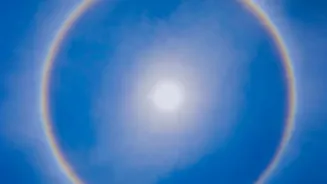
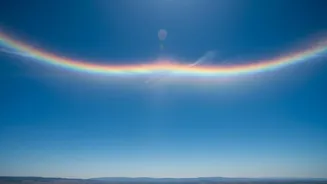
First, let's clear up the name. A 'fire rainbow' isn't related to fire, nor is it a true rainbow. The proper scientific term is a circumhorizontal arc. The name comes from its flame-like appearance, with vibrant pastel colours that seem to shimmer horizontally
across the sky, often parallel to the horizon. Unlike a traditional rainbow, which is caused by the reflection and refraction of light in water droplets and appears opposite the sun, a circumhorizontal arc is an ice halo. These arcs form in the same direction as the sun, but far below it.
The Secret Ingredient: Ice Crystals
The key to a fire rainbow lies high in the atmosphere, inside wispy cirrus clouds. These clouds exist at such high altitudes that they are composed not of water droplets, but of millions of tiny, hexagonal (six-sided) ice crystals. For a circumhorizontal arc to form, these ice crystals must be shaped like flat plates and oriented horizontally, like tiny saucers floating parallel to the ground. This specific alignment is crucial. As sunlight streams through the atmosphere, it enters the vertical side face of these ice crystals and exits through the bottom horizontal face.
A Celestial Prism Effect
This journey of light through the ice crystal is what creates the spectacle. The 90-degree angle between the entry and exit faces of the crystal causes the light to refract, or bend, splitting the white sunlight into its various colour wavelengths, much like a glass prism. When millions of these plate-like crystals in a cirrus cloud are aligned just right, the entire cloud can light up with a beautifully separated spectrum of colours, with red on top and violet at the bottom. The result is a vast, colourful band that can stretch for hundreds of miles across the horizon.
The Perfect Conditions for Skywatchers
Spotting a circumhorizontal arc is rare because the conditions have to be perfect. First, you need the right kind of clouds—thin, high-altitude cirrus or cirrostratus clouds containing those specifically shaped and aligned ice crystals. Second, and most importantly, the sun must be very high in the sky. To be precise, the sun's elevation must be greater than 58 degrees above the horizon. This is why the phenomenon is more common in mid-latitude locations during the summer months around midday, when the sun reaches its highest point. In fact, at latitudes above 55 degrees north or south, the sun never gets high enough for a fire rainbow to be seen.
How to Spot One in India
For skywatchers in India, the geographic location is a significant advantage. Being in the mid-latitudes means the sun often reaches the required 58-degree elevation, especially during the long days of late spring and summer. To maximize your chances, keep an eye on the weather for forecasts predicting high, wispy cirrus clouds on clear days. Look up during the midday hours, from late morning to early afternoon. Remember to look below the sun, not opposite it. Using polarizing sunglasses can also help make the colours more visible, especially if the arc is faint. While you can't predict them with certainty, being alert on sunny days with the right clouds is your best bet.
NASA's View From Above
While we look up from the ground, agencies like NASA often provide a different perspective. Images of atmospheric phenomena, like the recent Astronomy Picture of the Day from August 2, 2026, which featured a circumhorizon arc, play a crucial role in bringing these rare events to the public's attention. These stunning photographs, taken by professional and amateur astronomers alike, not only showcase the beauty of our planet's atmosphere but also serve as a valuable tool for scientific explanation and public engagement. They remind us that there are incredible natural spectacles happening all around us, often requiring just a little knowledge and a moment to look up.