





Beyond Standard Silicon
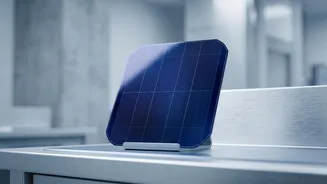
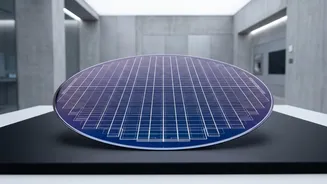
For decades, the solar industry has been dominated by silicon-based panels. They are reliable and have become progressively cheaper, forming the backbone of solar farms and rooftop installations across India. However, traditional silicon cells are approaching
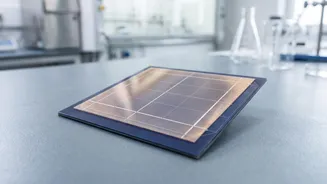
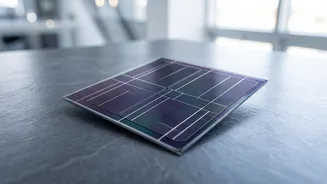
their theoretical efficiency limit of how much sunlight they can convert into electricity. Tandem solar cells are the next evolutionary step. They work by stacking a thin, specially engineered layer of a material called perovskite on top of a conventional silicon cell. This two-layer approach is more effective because each layer is designed to capture a different part of the solar spectrum; the perovskite top cell absorbs high-energy blue light, while the silicon bottom cell captures the remaining red and infrared light. This combination allows the tandem cell to break through the efficiency ceiling of silicon alone, generating significantly more power from the same surface area.
The 30% Efficiency Milestone
The solar research community has been buzzing with new records. Multiple research groups and companies, including LONGi, Oxford PV, and various universities, have demonstrated perovskite-silicon tandem cells with certified efficiencies exceeding 30% and even approaching 35% in laboratory settings. To put this in perspective, the standard commercial solar panels being installed today typically have an efficiency of around 22-24%. Achieving over 30% efficiency means these new cells can convert nearly a third of the sun's energy into electricity, a massive leap forward. This isn't just an incremental improvement; it signals a new frontier in photovoltaic capability. Critically, some of these breakthroughs, including research from IIT Bombay, are using scalable fabrication methods, which is a key step toward eventual mass production.
The Chasm Between Lab and Rooftop
While lab results are exciting, they don't mean these super-efficient panels will be available for purchase tomorrow. The biggest hurdle for tandem cells is proving their long-term durability. Solar panels are expected to last for 25 to 30 years in harsh outdoor conditions, withstanding intense heat, moisture, and UV radiation. Perovskite materials have historically shown vulnerability to degradation from these environmental factors. Researchers are making progress with better encapsulation techniques and more stable chemical formulas, but proving decade-spanning reliability is a slow process that can't be rushed. Furthermore, the record-breaking efficiencies are often achieved on very small, centimetre-sized cells. Scaling this performance up to a full-sized commercial module without significant efficiency loss is a major engineering challenge.
The Commercialisation Equation: Cost vs. Efficiency
For any new solar technology to succeed, it must be commercially competitive. Initially, tandem solar panels are expected to be more expensive than their silicon-only counterparts. However, their higher efficiency changes the economic calculation. Because a tandem panel produces more electricity, a project can generate the same amount of power with fewer panels. This reduces costs for land, mounting hardware, wiring, and labour. Some analyses suggest that a 32% efficient tandem panel could produce electricity at the same levelised cost as a 22% efficient silicon panel, even if the initial purchase price is higher. The key will be for manufacturers to scale up production, which will drive down costs. The industry predicts that tandem cells might reach cost parity with high-end silicon panels by 2028-2030 as the technology matures.
What This Means for India’s Solar Future
The implications for India are enormous. As a country with high population density and ambitious solar targets, maximising power generation from limited land and rooftop space is crucial. Higher-efficiency panels mean generating more clean energy from smaller footprints. This is particularly valuable for residential rooftops in crowded cities and for large-scale industrial projects where space is a premium. Indian institutions are already part of this global race. IIT Bombay has developed a tandem cell with nearly 30% efficiency, and a Grew Solar partnership aims to establish a manufacturing line in India. By encouraging domestic research and manufacturing through schemes like the Production Linked Incentive (PLI), India has an opportunity to become a leader in this next-generation technology rather than just a consumer.