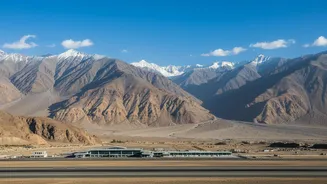








A Landing Above 10,000 Feet
Kushok Bakula Rimpochee Airport in Leh, situated at a breathtaking altitude of 3,256 metres (10,682 feet) above sea level, holds the distinction of being India's highest commercial airport. This fact alone makes it one of the most unique and challenging
airfields in the world. For passengers, the journey offers a spectacular introduction to the rugged beauty of Ladakh. The flight path weaves through a valley, with the Zanskar and Karakoram ranges unfolding below, providing a visual spectacle that begins long before you touch down. The descent is sharp, the turns are precise, and the entire experience serves as a powerful reminder that you are arriving in a land cradled by the world's mightiest mountains.
The Science of High-Altitude Flight
Landing at such an elevation is a masterclass in aerodynamics and precision. The air at 10,682 feet is significantly thinner than at sea level. This reduced air density affects aircraft in two major ways: it diminishes the lift generated by the wings and reduces engine power output. To compensate, pilots must approach the runway at a higher ground speed than usual, which in turn requires a longer runway to come to a safe stop. Furthermore, the airport is nestled in a valley, which creates its own set of meteorological challenges. Strong mountain winds often pick up in the afternoon, making landings and takeoffs hazardous. Consequently, all commercial flights are scheduled for the morning, when the air is typically calmer and more stable.
Only for Specially Trained Pilots
You won’t find a rookie pilot in the cockpit on a flight to Leh. The unique combination of high altitude, complex terrain, and a unidirectional runway—where planes must land from one direction and take off from the other due to rising terrain—mandates specialised training. Pilots must be certified specifically to operate flights into Leh. This training is rigorous and includes simulator sessions that replicate the challenging approach and potential engine failures in this demanding environment. They learn to fly a visual approach, navigating by sight through the mountain corridor without the aid of a standard Instrument Landing System (ILS), demanding immense skill and concentration.
A Strategic Lifeline for the Region
Beyond its status as a tourist gateway, Leh's airport is a critical piece of infrastructure with immense strategic importance. It serves as a vital military airfield for the Indian Air Force, enabling the transport of personnel and supplies to a sensitive border region. This dual civil-military role means security at the airport is paramount, with a significant army and police presence. For the people of Ladakh, the airport is an economic lifeline, particularly for the tourism industry, which is a cornerstone of the local economy. During the harsh winter months when high mountain passes are closed by snow, the airport provides year-round connectivity, ensuring the region is never completely cut off from the rest of the country.
The Gateway to Adventure
For travellers, landing at Kushok Bakula Rimpochee Airport is the first step into a world of high-altitude deserts, ancient monasteries, and unparalleled trekking opportunities. However, the rapid ascent by air from near sea level to over 10,000 feet requires immediate respect for the altitude. The most critical advice for anyone flying into Leh is to acclimatise properly. Medical experts and experienced travellers alike recommend dedicating the first 24 hours to complete rest to allow your body to adjust to the lower oxygen levels. Rushing into activity can lead to Acute Mountain Sickness (AMS), which can quickly derail an otherwise incredible trip. Once acclimatised, the wonders of Ladakh, from the serene Pangong Tso to the high passes of Khardung La, await.