


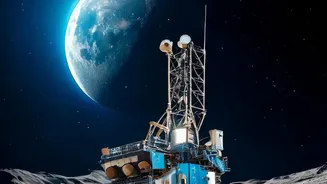
The Navigation Challenge on the Moon
Navigating on the Moon today is complex and inefficient. For decades, missions have relied on NASA's Deep Space Network (DSN), a global system of massive radio antennas, to track spacecraft. This method involves sending signals from Earth to a lunar asset
and measuring the response to calculate its position. While reliable, this process is slow, resource-intensive, and can only serve a limited number of missions at once. It's like having to make a long-distance call to a single operator every time you need to know your location. Furthermore, this system only works with a direct line of sight. Any mission on the far side of the Moon is completely cut off from Earth, creating a communications and navigation blackout.
Enter LunaNet: The Moon's Internet
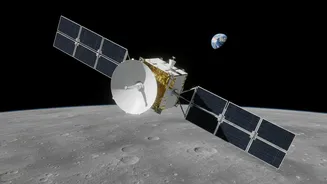
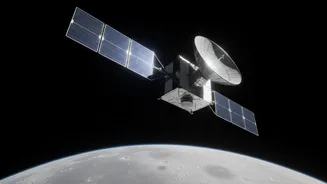
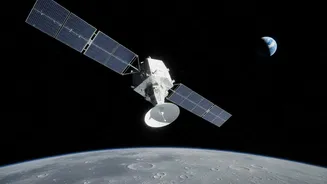
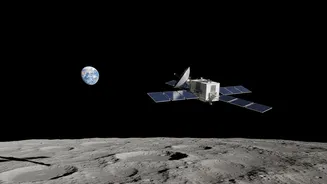
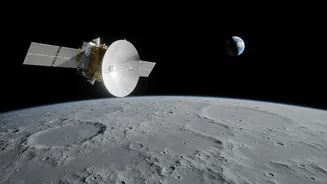
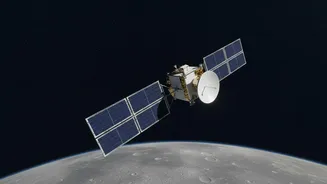
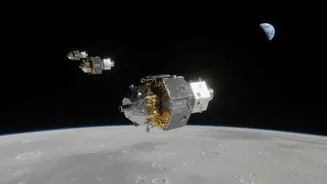
To solve this, NASA is developing LunaNet, a flexible and extensible framework designed to bring internet-like networking to the Moon. It isn't a single satellite or program, but an architecture of interconnected systems built by NASA, international partners like the European Space Agency (ESA), and commercial companies. The goal is to create a network of satellites orbiting the Moon that can talk to each other, to assets on the surface, and back to Earth. This approach moves away from the old model of pre-scheduled links with ground antennas and toward a system where rovers, landers, and astronauts can have a continuous connection. This 'internet of the Moon' will ensure reliable data delivery even when direct connections are disrupted.
Creating a Lunar Positioning System
Beyond basic communication, the true power of these relay satellites lies in creating a Positioning, Navigation, and Timing (PNT) service — essentially, a GPS for the Moon. Just like on Earth, where your phone uses signals from multiple GPS satellites to pinpoint your location, LunaNet will do the same for lunar explorers. A rover or an astronaut's suit will be equipped with a receiver that can get signals from several orbiting satellites. By calculating the time it takes to receive these signals, the receiver can determine its precise location on the lunar surface or in orbit, all without having to contact Earth. This enables autonomous navigation, a critical capability for a sustained presence.
Unlocking a Sustainable Lunar Economy
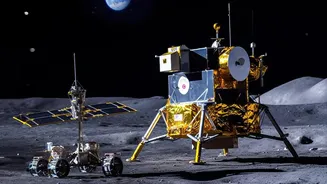
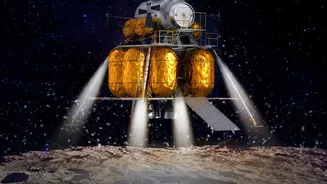
This GPS-like capability is about more than just convenience; it's a fundamental enabler of a future lunar economy. With precise, real-time navigation, commercial landers can touch down with pinpoint accuracy, delivering supplies exactly where they are needed. Rovers can navigate rugged terrain autonomously, expanding the reach of exploration and resource prospecting far beyond a lander's immediate vicinity. For astronauts on a spacewalk, knowing their exact position and having a reliable link back to their habitat is a massive boost for safety and efficiency. This robust infrastructure lowers the risk and cost for private companies, creating opportunities for everything from lunar logistics to mining and tourism.
More Than Just a Map
The LunaNet framework will provide more than just navigation. These satellites are also high-bandwidth data relays, capable of transmitting everything from scientific data to high-definition video from astronauts on the surface. This constant connectivity eliminates the communication blackouts that occur when a spacecraft is on the far side of the Moon. It also provides crucial information services, such as early warnings for solar radiation events, which are a significant danger to astronauts on the unprotected lunar surface. In essence, LunaNet is the foundational layer for all future activities, providing the digital roads and signposts necessary for humanity to live and work on another world.