

A Portrait of a Dying Star
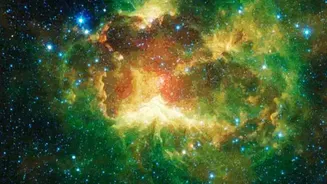
Far across the cosmos, about 5,000 light-years away in the constellation Gemini, a star much like our own Sun is putting on a final, spectacular show. This is NGC 2392, a celestial object nicknamed the Lion Nebula for its uncanny resemblance to a lion's
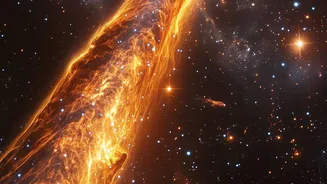
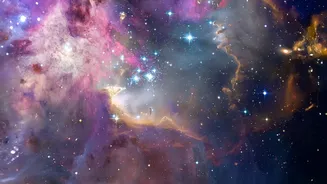
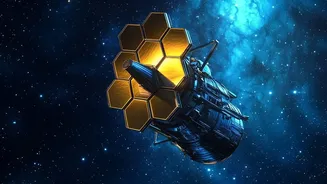
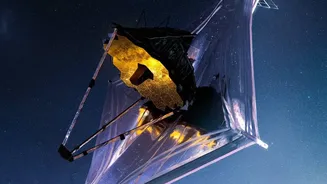
head, complete with a flowing mane. This is not a nursery for new stars, but rather a beautiful graveyard. Known as a planetary nebula, it is an expanding, glowing shell of gas and dust that was shed by the star as it reached the end of its life. For thousands of years, this material has been drifting outwards, creating the intricate patterns we see today. While the Hubble Space Telescope gave us our first famous look in 2000, the James Webb Space Telescope’s powerful infrared vision has now pierced through the cosmic dust to reveal the nebula in breathtaking new detail.
The Sculptor at the Center
At the heart of the Lion Nebula, acting as its bright 'nose', sits the culprit behind this cosmic sculpture: a white dwarf. This is the super-dense, scorching hot core left behind after the star exhausted its nuclear fuel and shed its outer layers. Though small, this stellar remnant is incredibly powerful. It blasts out intense radiation, effectively 'cooking' the surrounding nebula from the inside out. This outflow of energy is the chisel that carves the features of the lion. It pushes on the gas and dust, creating a vast, expanding bubble of ionised gas that forms the lion’s 'face'. The entire structure is a dynamic battlefield between the star’s relentless radiation and the material it once called its own.
Webb’s Infrared Dissection
This is where the Webb telescope truly shines, revealing what was previously hidden. Using its Near-Infrared (NIRCam) and Mid-Infrared (MIRI) instruments, Webb has provided a forensic analysis of the nebula’s sculpted gas. The images differentiate between the various components with stunning clarity. We can now clearly see the cavernous shells and rings of the central gas bubble. The 'mane' is revealed to be an inner shell of dust, illuminated by the central white dwarf. Most fascinating are the new details within this mane. Webb has highlighted dense clumps of dust that have managed to survive the star’s radiative onslaught. These resilient dust clusters act like shields, protecting the material directly behind them and creating long, comet-like tails. This allows scientists to study a live process of destruction and survival in a way that was never before possible.
More Than Just a Pretty Picture
While visually spectacular, this new portrait is a treasure trove of scientific data. Planetary nebulae are crucial for understanding the final life stages of most stars in the universe, including the eventual fate of our own Sun. By dissecting the fine filaments and knots of gas and dust in the Lion Nebula, astronomers can better model how these structures form and evolve. The image provides a perfect laboratory for studying the complex interaction between the intense radiation of a white dwarf and the material it has ejected. It helps answer key questions: Why do these nebulae form such complex shapes with rings and shells? How do some dusty regions survive while others are obliterated? Each new detail is a clue to the fundamental processes that govern the lifecycle of stars and enrich the galaxy with heavier elements.
A Fleeting Cosmic Masterpiece
Despite its grand appearance, the Lion Nebula is a fleeting phenomenon on a cosmic timescale. It has taken several thousand years for the dying star's cast-off layers to expand and form the structure we see today. Yet, this celestial artwork is not permanent. As the gas and dust continue to expand and drift away from the central star, the nebula will gradually thin out and fade into the interstellar medium. Astronomers estimate that in about 10,000 years, the lion will have completely dispersed, its roar fading into the silence of space. Webb’s image, therefore, is more than just a portrait; it is a snapshot, freezing a brief, beautiful, and violent moment in the life and death of a star.