

Our Galactic Next-Door Neighbour
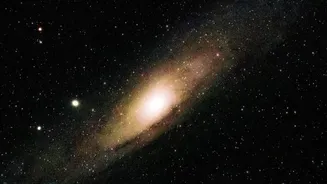
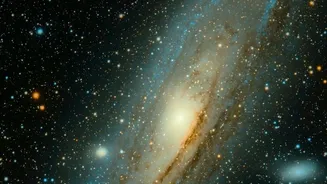
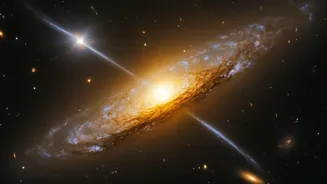
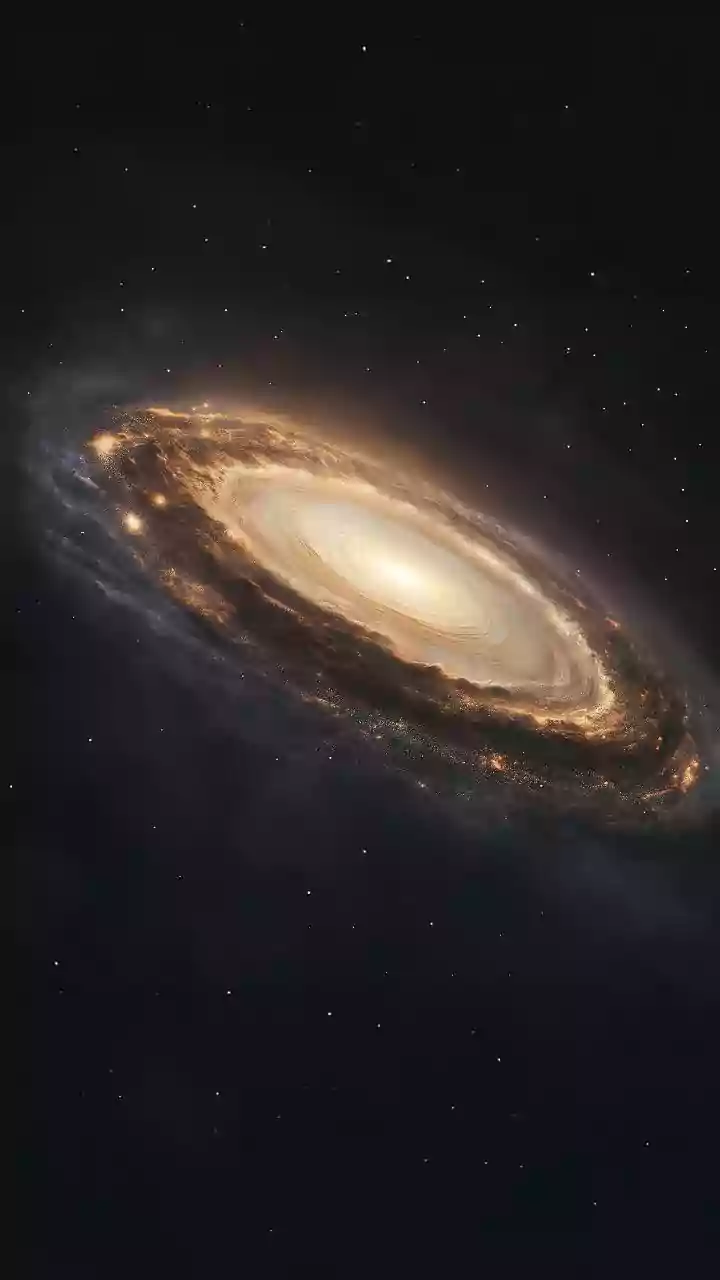
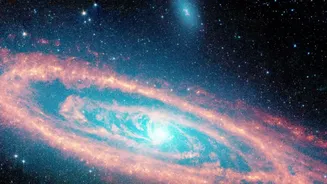
At just 2.5 million light-years away, the Andromeda galaxy, or M31, is the closest major spiral galaxy to our own Milky Way. It’s so close, in fact, that on a clear night in a dark sky, you can spot it without a telescope as a faint, fuzzy patch of light.
This proximity makes it a unique laboratory for astronomers. While we can get a detailed, ground-level view of our own galaxy, we can't step back to see its full structure. Andromeda, on the other hand, gives us a perfect outside perspective. It allows scientists to study a large galaxy as a whole, tracing its history and evolution in ways that are impossible from within the Milky Way. This is why the Hubble Space Telescope has spent decades mapping it in incredible detail.
A History Written in Starlight
A recent analysis of Hubble data has uncovered a dramatic chapter in Andromeda’s life story. Scientists already knew that about two billion years ago, Andromeda went through a massive baby boom, churning out stars at a furious rate, likely triggered by a collision with another, smaller galaxy. But the new study reveals what happened next: a long, steady decline. Over the past 500 million years, star formation has been winding down, with an even steeper drop in the last 40 million years. This finding comes from the Panchromatic Hubble Andromeda Treasury (PHAT) surveys, which mapped two-thirds of the galaxy's disk and measured around 200 million individual stars. By studying the colour and brightness of these stars—the 'fossil record' of the galaxy—astronomers can rewind time and reconstruct its star-making history.
The Cosmic Slowdown
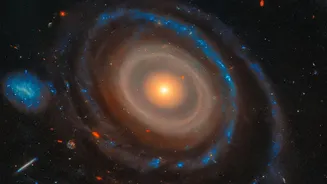
The numbers paint a vivid picture of this decline. About 500 million years ago, Andromeda was creating stars at a rate of about one solar mass per year—similar to the Milky Way's current pace. However, by 40 million years ago, that rate had been cut in half. Today, it has plummeted to just one-fifth of a solar mass per year. Much of this slowdown is linked to the fading of a hyperactive star-forming ring located about 32,000 light-years from the galactic centre. This ring was once responsible for a huge portion of the galaxy's new stars, and as its activity has waned, it has dragged down the galaxy's overall production rate. It's less a case of running out of fuel and more a galaxy entering a quieter phase of its life.
A Galactic Bully?
So, what’s causing this cosmic quiet down? While the fading of the star-forming ring is the direct cause, scientists have a prime suspect for a more disruptive influence: a small satellite galaxy called M32. Astronomers have long theorized that M32 may have plunged through Andromeda's disk hundreds of millions of years ago. The new Hubble data adds a compelling piece of evidence. The region of Andromeda closest to M32 shows a pronounced decrease in star formation that began around 60 million years ago. While researchers can't definitively say M32 is the culprit, the timing and location make it the 'most likely suspect' for disrupting the gas clouds and contributing to the slowdown in that area.
A Glimpse into Our Future
Studying Andromeda’s past is more than just cosmic history; it’s a potential preview of our own galaxy's future. The Milky Way and Andromeda are on a collision course, set to merge in about 4.5 billion years. This epic event will trigger a massive burst of star formation, similar to the one Andromeda experienced two billion years ago. Afterwards, our new, larger galaxy will likely follow a similar path of slowly winding down its star-making factories. By piecing together the story of our neighbour, we learn more about the life cycles of galaxies everywhere. The detailed maps from Hubble, and future observations from the Nancy Grace Roman Space Telescope, will continue to refine this story, helping us understand not just where other galaxies have been, but where our own is going.