

A Cosmic Cold Case
For decades, scientists have been puzzled by certain quirks of our Sun. When they compare standard models of how a star like ours should evolve with direct observations, things don’t quite line up. For instance, the Sun's surface has a surprisingly low
amount of the element lithium, which should be more abundant. Additionally, helioseismology—the study of vibrations and sound waves travelling through the Sun—has revealed subtle differences between its predicted and actual internal structure. These discrepancies have long suggested that a piece of the Sun's story was missing, pointing to a dramatic event in its distant past.
The Missing Planet Hypothesis
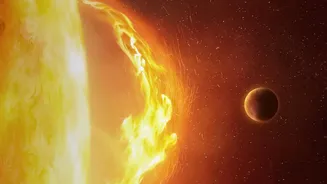
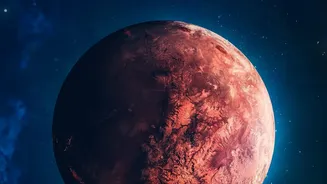
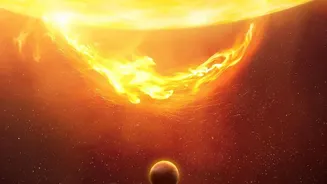
A new theory, put forth by researchers from Ege University in Turkey, offers a single, dramatic explanation for these puzzles: the young Sun swallowed a planet. Not just any planet, but a "super-Earth"—a class of rocky world five to ten times more massive than our own. While super-Earths are incredibly common in other star systems, our solar system conspicuously lacks one. Previous theories have suggested that super-Earths may have once formed close to the Sun, but their whereabouts remained unknown. This new study proposes that at least one of these massive worlds met a fiery end, spiralling into our star billions of years ago during the chaotic early days of the solar system.
The Chemical Fingerprints
According to the study, which was published in the Monthly Notices of the Royal Astronomical Society, such a massive collision would have left a lasting mark. The researchers used advanced computer models to simulate the Sun's evolution, testing how engulfing a planet would affect it. Their calculations showed that a super-Earth could have plunged through the Sun's outer layers without completely burning up, allowing its heavier materials to sink deep into the star's interior. This process would have altered the chemical composition deep inside the star, solving the puzzle of the depleted lithium and explaining the other structural anomalies observed today. The models converged on a planet in the 5-10 Earth-mass range, providing a specific and compelling scenario.
A Chaotic Early Solar System
The idea of a planet falling into its star isn't as far-fetched as it sounds. The early solar system was a violent and unstable place. Young planets migrated through a dense disc of gas and dust, their orbits shifting and sometimes crossing. It's perfectly consistent with our understanding of planet formation that one or more worlds could have been nudged into a decaying orbit, eventually being consumed by the powerful gravity of the young Sun. This theory not only provides an answer to questions about the Sun itself but also offers a neat explanation for why super-Earths are absent from our cosmic neighbourhood—ours may have become part of the star that now sustains us.
What Comes Next?
While the computer models are compelling, they don't constitute definitive proof. The next step for scientists is to search for independent, observable evidence of this ancient collision. The study's authors believe that the chemical and structural signatures predicted by their models could still be detectable within the Sun. If confirmed through helioseismology or other advanced observation techniques, the discovery would be monumental. It would not only rewrite a crucial chapter of our solar system's history but also prove that stars can preserve evidence of the planets they destroy for billions of years, acting as cosmic time capsules of their own violent pasts.