



The Cosmic In-Betweeners
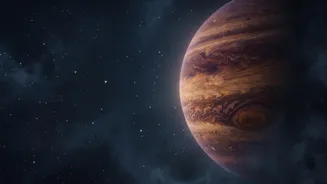
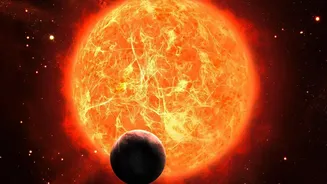
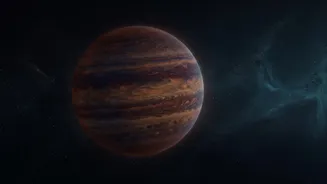
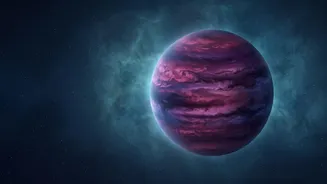
Imagine a celestial body more massive than Jupiter, but not quite hefty enough to ignite and become a star like our Sun. That's a brown dwarf. Often called 'failed stars', they are born from the same collapsing clouds of gas and dust that create stars.
However, they never accumulate the critical mass needed to kickstart sustained nuclear fusion of hydrogen in their cores, the process that makes stars shine. While they don't shine like a star, they aren't exactly planets either. Many drift through space alone, glowing dimly from the residual heat of their formation and sometimes briefly fusing a heavier type of hydrogen called deuterium.
A Tale of Two Formation Stories
The traditional dividing line between stars and planets has always been their origin story. Stars form from the top-down, through the immense gravitational collapse of a gas cloud. Planets, on the other hand, are thought to form from the bottom-up, built within the leftover disk of material swirling around a newborn star. For a long time, this distinction worked well. But brown dwarfs complicate this neat picture. They form like stars, but their physical characteristics, like having complex, cloudy atmospheres, can be remarkably similar to gas giant planets. This overlap has created a persistent identity crisis for astronomers.
New Discoveries Blur the Lines Further
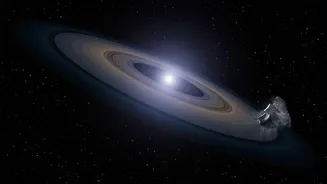
Recent findings, particularly from NASA's James Webb Space Telescope (JWST) and the SPHEREx telescope, are making the distinction even fuzzier. One major line of inquiry has focused on the very smallest objects that can be formed through star-like collapse. In a young star cluster called IC 348, astronomers have found brown dwarfs with masses just two to four times that of Jupiter. This is remarkably small, straining theoretical models of how stars are supposed to form and pushing brown dwarfs deep into territory once reserved for planets. To make things even more complex, one of these tiny brown dwarfs showed signs of having its own disk, suggesting planets could form around an object that is itself the mass of a planet.
It's All in the Atmosphere
Other new research from NASA's SPHEREx telescope is focusing on the atmospheres of these strange worlds. By analysing the infrared light from dozens of brown dwarfs, scientists have found that they have chemically rich atmospheres containing water, methane, carbon monoxide, and carbon dioxide. While this sounds planet-like, the key finding is their incredible diversity. Even at the same temperature, no two brown dwarfs seem alike, with cloudy transitions that current atmospheric models struggle to explain. Some of the smallest brown dwarfs even show the signature of a mysterious hydrocarbon molecule never before detected outside our solar system, leading some scientists to propose they may belong to a whole new spectral class.
Why This Cosmic Identity Crisis Matters
Figuring out brown dwarfs isn't just about cosmic classification. These objects are crucial laboratories for understanding both star and planet formation. Because many brown dwarfs float freely in space, they can be studied in great detail without the blinding glare of a host star, which often hides giant exoplanets. By observing their complex weather and atmospheric chemistry, scientists can get a clearer picture of the physics that governs gas giants like Jupiter and Saturn. The new discoveries show that nature is more creative than our models, producing a continuous spectrum of objects rather than fitting into tidy boxes. Each brown dwarf is a clue, helping to refine our theories on how everything from the smallest planets to the most massive stars come to be.