



A Sweet Find in a Cosmic Nursery
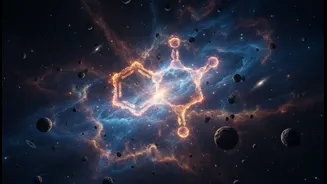
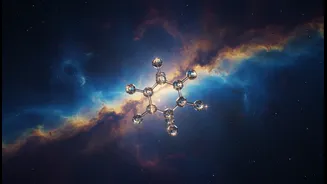
Astronomers have found molecules of glycolaldehyde, a simple form of sugar, in the gas surrounding young, Sun-like stars. One of the most significant detections occurred around a binary star system called IRAS 16293-2422, located about 400 light-years
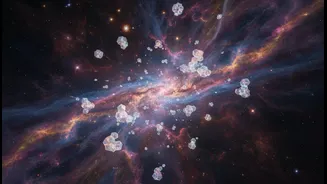
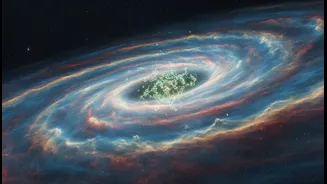
from Earth. This star system is still in its infancy, shrouded in a vast disk of gas and dust—the very material from which planets are formed. While this isn't the kind of sugar you'd put in your morning chai, its presence is a landmark discovery. It's the first time such a molecule has been found so close to a star of our sun's type, at a distance comparable to that of Uranus in our own solar system. This means the sugar exists right where a new planetary system is being assembled.
More Than Just an Ingredient
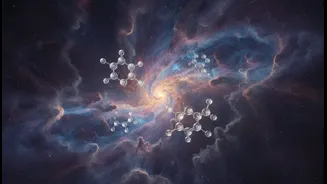
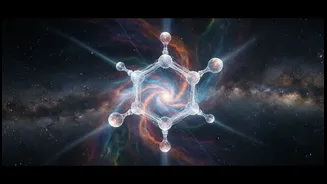
Glycolaldehyde is what scientists call a prebiotic molecule. It's not life itself, but it is a crucial ingredient in the recipe for creating it. Specifically, this simple sugar is one of the components needed to form Ribonucleic acid, or RNA. RNA is a close relative of DNA and is considered by many scientists to be a precursor to the emergence of life on Earth. Finding glycolaldehyde in a protoplanetary disk suggests that the chemical starting blocks for life are available long before planets are even fully formed. This finding supports the idea that the basic chemistry for life isn't unique to Earth but could be a common feature of star systems across the galaxy.
Refining the Planetary Playbook
This discovery challenges and refines our understanding of how planets evolve chemically. Traditionally, some models suggested that the intense radiation and violent processes of a new star's birth would destroy complex molecules, forcing a chemical 'reset'. In that scenario, the building blocks for life would have to form later, on the surfaces of newly formed planets. However, finding sugar already present in the protoplanetary disk shows that these complex organic molecules can survive the chaotic star-formation process. Even more excitingly, observations show the sugar molecules are not just present, but are actively falling inward toward one of the young stars. This means they are on the correct trajectory to be incorporated into any planets, comets, or asteroids that form in the system.
The Tools of Discovery
Detecting a specific molecule hundreds of light-years away is no easy feat. This breakthrough was made possible by highly sensitive radio telescopes, most notably the Atacama Large Millimeter/submillimeter Array (ALMA) in Chile. Telescopes like ALMA don't see stars in the way we do with our eyes. Instead, they detect the faint radio waves emitted by molecules as they rotate and vibrate in space. Every molecule has a unique radio 'fingerprint', a specific set of frequencies it emits. By matching the signals coming from the star system IRAS 16293-2422 to the known fingerprint of glycolaldehyde, astronomers could confirm its presence with confidence. The incredible sensitivity of ALMA was crucial for spotting these faint signals from the cosmic dawn of a new solar system.
From Stardust to Life's Recipe
The implications of this cosmic sugar are profound. It adds weight to the theory that Earth may have been 'seeded' with the essential ingredients for life by comets and asteroids early in its history. These celestial bodies are leftovers from the formation of the solar system, containing a chemical snapshot of the cloud from which they were born. If the cloud that formed our sun and planets also contained sugars and other prebiotic molecules, it's plausible they were delivered to a young Earth, providing a kick-start for life to begin. The discovery shifts our perspective: the building blocks of life may not need to be cooked up on a planet's surface from scratch, but could be delivered ready-made from interstellar space.