


A Tale of Two Sun-Watchers
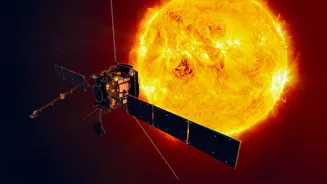
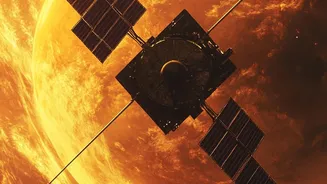
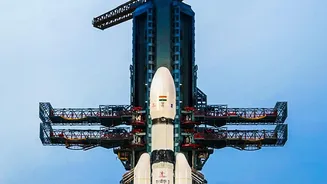
Imagine two expert detectives assigned to the same case, each with a unique set of skills. That's the story of ISRO's Aditya-L1 and the European Space Agency's (ESA) Proba-3. Aditya-L1, India's first dedicated solar observatory, is strategically parked
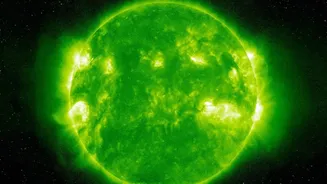
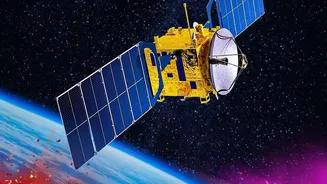
at Lagrange Point 1 (L1), giving it a continuous, uninterrupted view of the Sun. Its seven advanced instruments study everything from the Sun's outer layers to the solar wind, the stream of charged particles constantly flowing from our star. Proba-3, on the other hand, is a marvel of precision engineering. It consists of two satellites flying in perfect formation, 150 meters apart, to create an artificial solar eclipse. This allows its main instrument, a coronagraph named ASPIICS, to peer into the Sun's inner corona—a region notoriously difficult to observe—with stunning clarity. While Aditya-L1 provides the wide context and measures the solar wind, Proba-3 zooms in on the very origin of solar fireworks.
A Landmark Scientific Collaboration
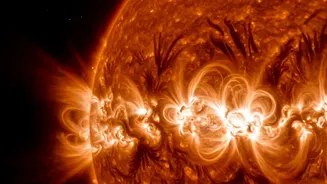
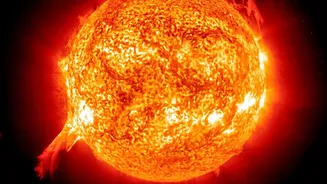
For the first time, scientists have combined the observations of these two powerful missions to study the same solar events. This joint effort, led by researchers at the Indian Institute of Astrophysics in Bengaluru, focused on Coronal Mass Ejections (CMEs)—colossal eruptions of plasma and magnetic fields from the Sun. Observing these events close to the solar surface has always been a major challenge for scientists. By pairing Aditya-L1's VELC instrument, which performs spectroscopic analysis, with Proba-3's ASPIICS imager, the team could cross-check their data and build a much more complete picture of the eruptions. This synergy allows for independent but complementary measurements of a CME's mass, density, and, crucially, its energy right from its birth.
Cracking the Energy Code
The study provided detailed measurements of the different types of energy in a CME: kinetic (from its motion), thermal (from its heat), and magnetic. Understanding this energy budget is key to predicting how a CME will behave as it travels through space. The team analysed two specific CMEs observed in September 2025, one moving at a brisk 645 km/s and a slower one at 145 km/s. The combined observations allowed them to precisely calculate how much energy was contained in the mass, heat, and magnetic field of each eruption as it left the Sun. Previously, such detailed energy breakdowns so close to the solar surface were poorly constrained. This new level of detail provides critical new constraints for the models that scientists use to forecast space weather, moving from educated guesses to data-driven analysis.
Why This Solar Data Matters for India
So, why should we care about the energy of an explosion happening 150 million kilometres away? Because when a CME is aimed at Earth, it can have serious consequences. These solar storms can disrupt Earth's magnetic field, creating geomagnetic storms. This can damage or disable critical satellites used for communication, GPS navigation, and weather forecasting. They can also interfere with high-frequency radio communications used by aviation and the military, and in extreme cases, induce currents that can knock out power grids. For a nation like India, with its rapidly expanding digital economy, extensive satellite network, and reliance on precise navigation, the ability to accurately predict the arrival and intensity of a solar storm is not just a scientific curiosity—it is a matter of national security and economic stability.