


The Classic Story of a Cosmic Crash
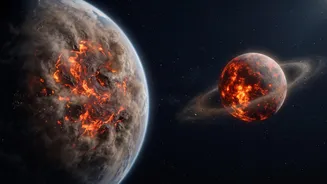
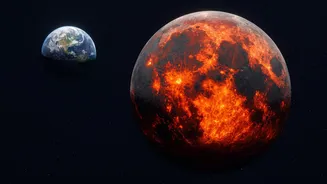
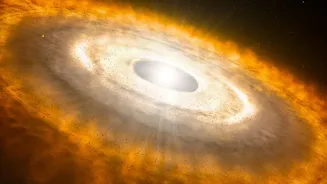
For the better part of half a century, the leading scientific explanation for the Moon's existence has been the "Giant-Impact Hypothesis." The story goes like this: about 4.5 billion years ago, when our solar system was still a chaotic construction zone,
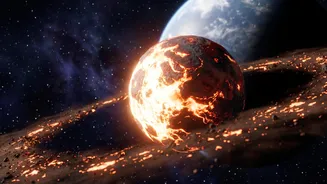
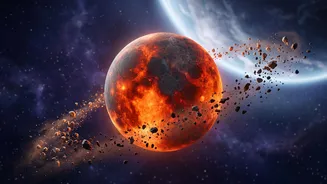
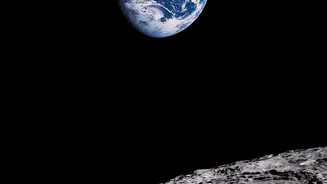
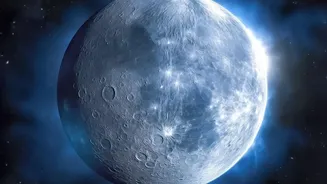
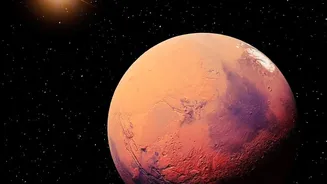
a protoplanet roughly the size of Mars smashed into a young, molten Earth. This impactor was given the name Theia, after the Greek titan who was the mother of the moon goddess, Selene. The collision was so violent that it blasted a colossal amount of vaporized rock and debris into orbit around our planet. According to this model, this ring of material then slowly, over the course of months or even years, coalesced under gravity to form the Moon we know today. Evidence from the Apollo moon rocks, which showed the Moon was once covered in a magma ocean and had a similar chemical makeup to Earth's mantle, gave this theory significant weight over other ideas.
A Theory with Lingering Questions
Despite its widespread acceptance, the Giant-Impact Hypothesis isn't perfect. One of the biggest unresolved issues is the remarkable chemical similarity between Earth and the Moon. Isotope analysis of lunar samples shows they are almost identical to Earth rocks. If the Moon formed mostly from the debris of Theia, as early simulations suggested, it should have a distinct chemical fingerprint, different from Earth's. Scientists have proposed various complex scenarios to account for this, such as an incredibly thorough mixing of materials post-impact, but no single explanation has been entirely satisfactory. The theory also struggles to perfectly account for the Moon's current orbit, which is tilted and has other specific properties that are difficult to replicate in models of a slow, gradual formation from a debris disk.
Enter the Supercomputers
This is where modern technology changes the game. Researchers at NASA's Ames Research Center and Durham University have been running new, extremely high-resolution simulations of this ancient cosmic collision. Using the power of modern supercomputers, they can model the impact with a much higher particle count, revealing details that were previously invisible in lower-resolution models. These simulations allow scientists to explore a wider range of variables, such as the angle of impact, the spin of the two bodies, and crucially, their internal temperatures and material properties just before the crash. It turns out that these initial conditions, particularly the heat and plasticity of the young planets, can dramatically alter the outcome.
A Moon in Mere Hours?
The most startling result from these new simulations is the possibility of a near-instantaneous Moon formation. Instead of forming a debris ring that takes months or years to accrete, some models show the impact launching a large, intact clump of material directly into a stable orbit around Earth. This proto-Moon, a mix of material from both Earth's mantle and the obliterated Theia, could have formed in as little as five hours. This single-stage formation offers a more elegant solution. A hotter, softer Theia impacting a young Earth results in a scenario where the Moon emerges almost fully formed from the cataclysm, rather than being built piece by piece over a long period.
What the New Evidence Suggests
This rapid-formation model provides compelling answers to some of the old theory's biggest problems. Because the impact launches a chunk of Earth's own mantle directly into the final satellite, it more easily explains the uncanny chemical similarities between our two worlds. The outer layers of the Moon would be predominantly made of Earth material, matching the data from the Apollo samples. Furthermore, this immediate creation process opens up new possibilities for the Moon’s early orbital evolution, potentially providing a cleaner explanation for its current tilt and trajectory. While the classic model required a very specific set of circumstances to work, the immediate-formation scenario appears to solve multiple puzzles in one go.