


A Cosmic Detective Story
Imagine trying to piece together the details of a car crash that happened 10 billion years ago with no witnesses. This is the challenge facing astronomers, and their breakthrough is thanks to the European Space Agency's Gaia mission. This powerful space
telescope has been meticulously mapping the positions, movements, and chemical compositions of over a billion stars in our galaxy. By studying this treasure trove of data, scientists act as cosmic detectives, tracing the ghostly remnants of ancient events that shaped the Milky Way we inhabit today. A recent presentation at the 2026 National Astronomy Meeting by Durham University researchers has provided a stunning new chapter in this story.
The Intruder from the Past
The culprit in this ancient drama is a dwarf galaxy that astronomers have colorfully nicknamed 'Gaia-Sausage-Enceladus'. The name comes from the sausage-like shape that the orbits of its leftover stars form within the Milky Way's data plots. This wasn't a small fender-bender; Gaia-Sausage was a massive object in its own right, boasting a mass over 10 billion times that of our sun. Sometime between 8 and 11 billion years ago, long before our own Sun and Earth formed, this galaxy plunged head-on into the young Milky Way. It didn't survive the encounter, being torn to shreds by the Milky Way’s much stronger gravity.
What It Means to Flip a Galaxy
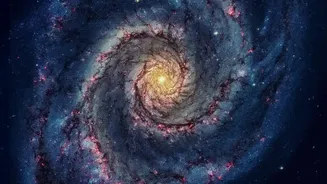
The collision was catastrophic. But what does it actually mean for a galaxy to 'flip'? Space has no up or down, so the concept refers to the galaxy's axis of rotation. Using powerful supercomputer simulations, astronomers showed how such a massive, head-on impact could cause the entire flat, spinning disk of the Milky Way to slowly, dramatically reorient itself. This process wasn't instantaneous; it was a slow-motion somersault that likely took hundreds of millions of years to complete. The entire plane of stars, gas, and dust—including the material that would one day form our solar system—was gradually redirected into a new orientation, flipping by more than 90 degrees.
Evidence Written in the Stars
The key piece of evidence that led to this discovery is a long-standing galactic mystery: the behaviour of the stellar halo. This is a sparse, spherical cloud of ancient stars that surrounds the main galactic disk. While stars in the disk (like our Sun) zip around the galactic center at high speed, the stars in the halo move remarkably slowly. For years, astronomers couldn't explain why. The new simulations reveal that galaxies that experience both a massive head-on collision and a subsequent disk flip end up with these exact slow-moving halos. The collision with Gaia-Sausage provides the perfect explanation for the strange behaviour of our galaxy's oldest stars, which are the lasting fingerprints of this ancient impact.
A New Understanding of Our Home
This discovery doesn't just solve an old puzzle; it fundamentally changes our perception of the Milky Way's life story. It shows that our galaxy is not an isolated, peacefully evolving system, but the dynamic and violent product of cosmic cannibalism. The collision with Gaia-Sausage didn't just leave behind a halo of stars; it likely triggered a wave of new star formation, puffed up the galactic disk, and created the central bulge we see today. It means that everything we see, including the path our Sun takes through the galaxy, is a direct consequence of this ancient crash. Our galaxy's history is written not just in its stars, but in their very motion across the sky.