




Defining ‘Enough’ Space
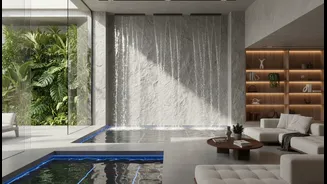
When designers say a large waterfall needs 'enough' space, they’re talking about more than just the physical footprint. A grand water feature requires significant visual clearance to prevent it from overwhelming a room. Think of it like a sculpture in a gallery;
it needs breathing room. A rule of thumb is to ensure the waterfall's height doesn't exceed 60-70% of the ceiling height to maintain a sense of proportion and avoid a cramped feeling. The space around it should be uncluttered, allowing the waterfall to draw the eye without competing with furniture or other decor. This negative space is just as important as the feature itself for establishing it as the room’s centrepiece.
The Technical Footprint You Don't See
Beyond the visible structure, a large waterfall has hidden space requirements. Every installation needs a basin or reservoir to hold the water, a pump to circulate it, and often a filtration system. These components must be accessible for regular maintenance and repairs. For substantial waterfalls, this mechanical equipment can be quite large and is often concealed within cabinetry, a soffit, or a dedicated utility closet nearby. Furthermore, the weight is a major factor. Water is heavy, and when combined with materials like stone or glass, the total load can be immense. The floor must be structurally sound enough to support it, which may require reinforcement and professional assessment before installation begins.
The Science of Sound and Scale
The sound of a waterfall is one of its main attractions, but in the wrong space, it can turn from soothing to stressful. In a small, enclosed room, the sound of a large volume of cascading water can become an overpowering roar. Larger, open-plan spaces with high ceilings are better equipped to handle the acoustics, allowing the sound to dissipate naturally. The material of the waterfall itself also plays a role; water flowing over textured stone creates a different sound than water sheeting down smooth glass. Designers can manipulate these acoustics, but the room's volume is the primary factor in determining whether the sound is a gentle background burble or an intrusive noise.
Managing Moisture and Humidity
All indoor water features act as natural humidifiers by releasing water vapour into the air through evaporation. While this can be a benefit in dry climates, a large waterfall can release a significant amount of moisture. In a space without adequate air circulation or a robust HVAC system designed to handle the extra moisture load, this can lead to problems like condensation, damp smells in fabrics, and even the growth of mould and mildew, which can damage walls and furniture. Therefore, the room must have proper ventilation to manage the increased humidity, a critical consideration that ties back to the overall size and quality of the space.
Lighting and Integration
For a waterfall to truly be a focal point, especially after dark, it needs strategic lighting. This isn't just about illuminating the feature, but about creating drama and highlighting the movement of the water. This requires space for installing uplights, downlights, or backlighting. The surrounding decor must also be planned with the waterfall in mind. Furniture should be arranged to offer clear sightlines, and materials for flooring and walls should be chosen to complement the feature and withstand potential splashes or high humidity. A large waterfall isn't just an accessory; it's a major architectural element that must be seamlessly integrated into the room’s design.