





What Did the Rovers Actually Find?
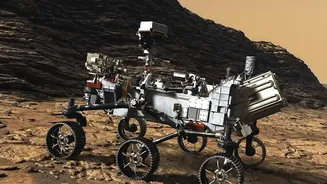
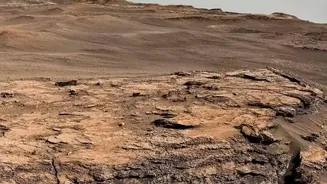
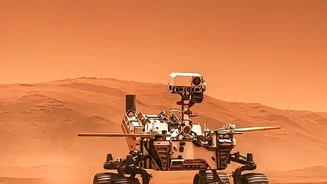
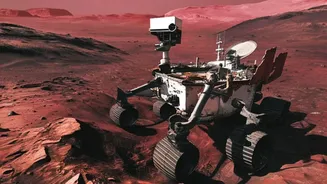
Recent announcements centre on discoveries made by both the Curiosity and Perseverance rovers in different locations on Mars. In the Jezero Crater, an area believed to have once been a lake and river delta, the Perseverance rover identified complex, ring-shaped
carbon molecules. Using its SHERLOC instrument, the rover detected what is known as macromolecular carbon preserved in ancient mudstones. Separately, in Gale Crater, the Curiosity rover found the largest and most diverse collection of organic molecules ever identified on the planet, including some never seen there before. These molecules include long carbon chains that are consistent with fragments of fatty acids, which on Earth are fundamental building blocks for life.
Why This Is a Clue for 'Habitability'
The key to this discovery is understanding what scientists mean by “habitability.” It doesn't mean a place is inhabited, but rather that it has the necessary ingredients for life as we know it. These include liquid water, a source of energy, and chemistry based on carbon. The latest findings strengthen the case for Mars's past on multiple fronts. The Perseverance rover found its organic molecules in rocks known to form in water, like clays and carbonates, suggesting these building blocks were present in a watery environment. The discovery of various minerals alongside these organics also points to multiple, distinct periods when liquid water altered the rocks, creating diverse environments over a long time. This suggests that habitable conditions weren't just fleeting but potentially widespread and long-lasting.
The Crucial Caveat: No Proof of Life
It is critical to understand that finding organic molecules is not the same as finding life. These complex carbon-based compounds can be created by both biological processes (like decaying organisms) and normal geological processes that have nothing to do with life, such as reactions between water and rock or delivery by meteorites. The instruments on the Mars rovers are sophisticated enough to detect these molecules but cannot determine their origin. As such, scientists are careful to state that while the findings make Mars a more compelling place to search for past life, they do not provide proof. The discovery shifts the scientific question from if Mars was habitable to how far its chemistry progressed toward life.
The Business of Answering the Big Question
These incremental but profound discoveries have huge implications for the business of space exploration. Each new clue that points toward past habitability helps justify the immense public and private investment required for Martian missions. Rovers like Perseverance and Curiosity are marvels of engineering, representing billions of dollars and decades of work from countless scientists, engineers, and technicians. The findings reinforce the scientific strategy behind these missions and provide the crucial data needed to plan the next, even more ambitious, steps. The ultimate goal for many in the field is a Mars Sample Return mission, an incredibly complex and expensive undertaking designed to bring Martian rocks back to Earth. Only in advanced labs on our own planet can scientists use instruments powerful enough to potentially answer the question of whether life ever existed there.
What's Next in the Hunt for Martian Life?
The rovers' work is far from over. Perseverance is currently sealing the most promising rock core samples in titanium tubes, leaving them on the Martian surface for a future mission to collect. The recent discoveries will help scientists prioritize which samples are the most scientifically valuable. Meanwhile, research continues here on Earth to better understand how non-biological processes could create the molecules seen on Mars, helping to narrow down the possibilities. The European Space Agency is also planning its own rover, Rosalind Franklin, which will specifically target clay deposits with a drill that can reach deeper beneath the surface radiation, potentially finding better-preserved biosignatures. The search is a slow, methodical process, but each discovery brings us one step closer to knowing if Earth is the only world in our solar system to have ever hosted life.