


1. The Afro
A true icon, the Afro is the ultimate celebration of natural volume and texture. It rose to prominence during the Black Power movement of the 1960s and '70s as a powerful symbol of pride, resistance, and the "Black is Beautiful" ethos. More than just
a hairstyle, it was a declaration against conforming to Eurocentric beauty standards. Today, the Afro remains a timeless statement of confidence. It works with the hair's natural growth pattern, allowing coils and kinks to form their characteristic rounded shape. There is no single 'correct' way to wear an Afro; it can be shaped, picked out for maximum volume, or worn closer to the head. Its beauty lies in its versatility and its unapologetic embrace of hair as it naturally grows. It’s a style that inherently rejects the need to alter or suppress texture.
2. Bantu Knots
With deep roots in the cultures of the Bantu peoples across Southern Africa, Bantu knots are both a stunning hairstyle and a protective method. Also known as Zulu knots, this style involves sectioning the hair, twisting each section, and wrapping it into a small, tight knot close to the scalp. They are a powerful cultural statement, symbolizing beauty and heritage. The style is incredibly versatile, working on all hair lengths and textures. Worn as a finished look, Bantu knots are a bold, geometric statement. They can also be used as a heat-free way to create defined, springy curls—when the knots are taken down, the result is a beautiful 'Bantu knot-out'. This dual purpose makes them a classic, practical choice that honors the hair's texture while providing a range of styling options.
3. Twists and Twist-Outs
The two-strand twist is a foundational style in the natural hair community. It’s created by taking a section of hair, dividing it into two, and wrapping the strands around each other from root to tip. Twists can be worn as a protective style on their own, keeping the ends of the hair tucked away and moisturized. They can be thin or chunky, long or short, making them adaptable to any preference. However, their second act is what makes them a true classic: the twist-out. After the twists are allowed to dry completely, they are carefully unraveled to reveal a defined, spiraled curl pattern. This method enhances and defines the hair's natural texture without heat, creating a consistent yet beautifully natural look that is full of body and movement.
4. Classic Braids (Cornrows and Box Braids)
Braiding is an ancient art form with a history spanning thousands of years, particularly in African cultures where styles could signify everything from tribe to social status. Two of the most enduring and classic braided styles are cornrows and box braids. Cornrows are braided close to the scalp, offering endless design possibilities from simple, straight-back styles to intricate patterns. Box braids, named for the square-shaped parts at the root, are individual plaits that can be styled in numerous ways. Both are excellent protective styles, but their classic status comes from their ability to be both practical and expressive. They don't require the hair's texture to be altered, instead working with it to create a look that is both neat and culturally significant.
5. The Wash-and-Go
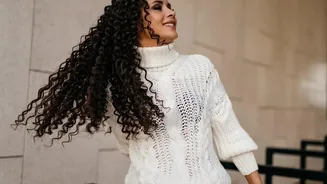
Perhaps the most authentic celebration of natural hair is the wash-and-go. The name is slightly misleading—it involves more than just washing and heading out the door. The process typically means cleansing and conditioning the hair, then applying styling products like a leave-in conditioner and gel to define and hold the hair's natural curl pattern while it's still wet. The hair is then left to air-dry or dried with a diffuser. The goal isn't to create a new texture but to enhance the one you already have, encouraging curls and coils to form without frizz. It is the epitome of working with your hair, not against it, allowing each unique curl pattern to shine through. Mastering a wash-and-go is a journey of learning what your specific hair needs, making it a deeply personal and empowering style choice.