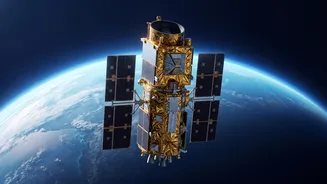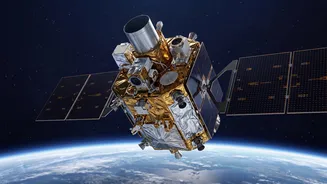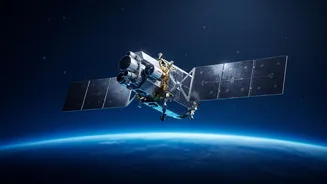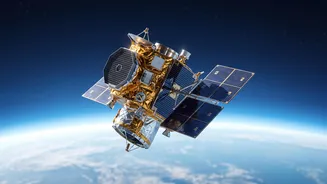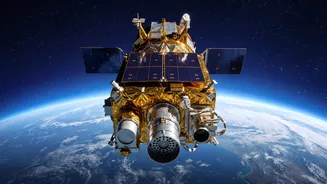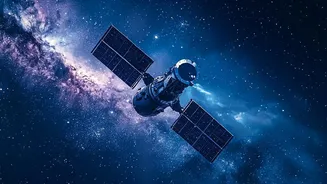

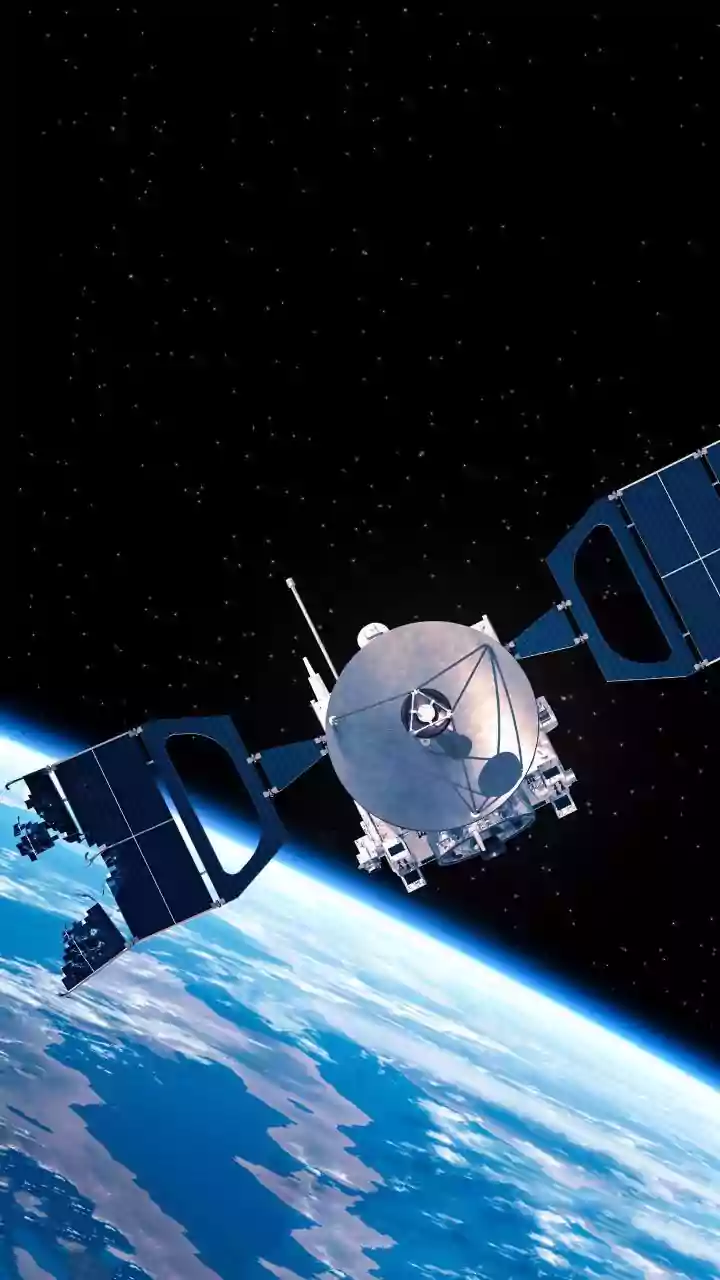



After an incredible journey spanning almost 22 years, NASA's legendary Neil Gehrels Swift Observatory concluded its mission in a fiery atmospheric re-entry on November 4, 2026. This marks the end of an era for a workhorse satellite that far outlived its original
two-year plan.
The Final Plunge
On November 4, 2026, the Swift Observatory made its final descent, breaking apart as it entered the atmosphere over the North Sumatra region of Indonesia. The end was not unexpected. For years, increased solar activity had caused Earth's upper atmosphere to expand, creating more drag on the low-orbiting satellite and gradually pulling it down. An ambitious commercial rescue mission launched in July 2026 to boost the observatory into a higher orbit was unsuccessful, sealing Swift's fate. With its orbit decaying to a point where it could no longer hold steady, NASA officially concluded science operations on October 20, paving the way for its final, uncontrolled re-entry. While most of the 1.5-ton spacecraft burned up, some components were expected to survive the plunge.
A Mission Built for Speed
Launched on November 20, 2004, the Swift Gamma-Ray Burst Explorer was designed with a singular, crucial capability: speed. Its primary goal was to solve the mystery of gamma-ray bursts (GRBs), the most powerful explosions in the universe, which can flash and fade in mere minutes. Before Swift, these events were nearly impossible to study in detail because telescopes couldn't be aimed at them fast enough. Swift changed everything. Using a three-telescope system, its Burst Alert Telescope would first detect a flash of gamma rays. The spacecraft would then autonomously and rapidly 'slew', or pivot, to aim its powerful X-ray and Ultraviolet/Optical telescopes at the source in as little as 60 to 90 seconds to capture the fading afterglow. This process, once taking hours or days, became nearly instantaneous, revolutionizing the field.
Unlocking the Violent Universe
Armed with its rapid-response capability, Swift became one of the most productive astrophysics missions in history. Designed for a two-year mission, it operated for over two decades, detecting more than 2,000 gamma-ray bursts. It pinpointed the origins of both long GRBs, caused by the collapse of massive stars, and short GRBs, resulting from the collision of dense neutron stars. The observatory spotted some of the most distant objects ever seen, including a GRB from when the universe was just 630 million years old, providing a window into the cosmos's infancy. One burst it detected was so bright it would have been visible to the naked eye, despite being 7.5 billion light years away.
More Than a One Trick Pony
While GRBs were its main focus, Swift's versatility made it an indispensable tool for all kinds of astronomy. Its ability to quickly observe any transient event made it a go to observatory for a wide range of cosmic phenomena. Over its lifetime, Swift studied over 1,400 supernovae, or exploding stars. It witnessed stars being torn apart by supermassive black holes, monitored comets in our own solar system, and studied powerful flares from nearby stars. Crucially, when the first gravitational waves from a neutron star merger were detected in 2017, Swift was among the first telescopes to observe the resulting 'kilonova' explosion, confirming where the universe's heavy elements like gold and platinum are forged.