


A Cosmic Ménage à Trois
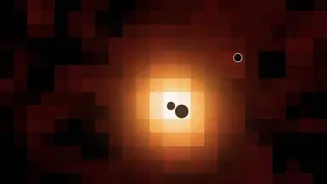
Astronomers using the James Webb Space Telescope (JWST) have identified the first-ever trio of actively feeding supermassive black holes within a single galaxy, known as J0148-4214. We are seeing this system as it existed 12.5 billion years ago, providing
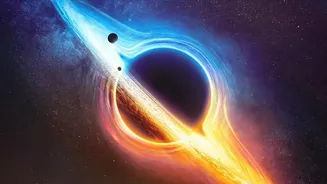
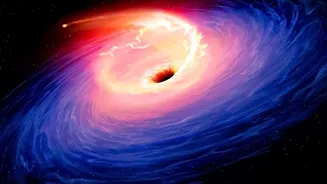
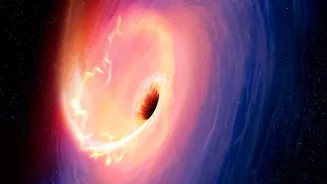
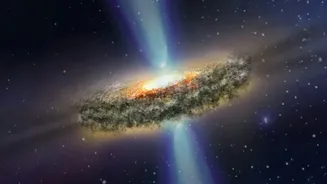
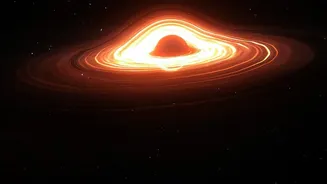
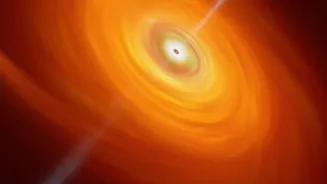
a remarkable snapshot of the infant universe. Two of the black holes are nestled closely together in the galaxy's core, separated by a mere 620 light-years, while a third lurks further out. This isn't just a curiosity; it's a live-action shot of what scientists have long suspected is a primary engine of cosmic growth. The black holes are not dormant; they are active quasars, meaning they are voraciously consuming surrounding gas and dust, which causes them to shine with incredible brightness across the vastness of space.
How They Found the Trio
Spotting these objects was a triumph of technology and technique. The galaxy J0148-4214 is so distant that the black holes themselves cannot be imaged directly. Instead, an international team led by researchers at the Max Planck Institute for Extraterrestrial Physics used the JWST's powerful Near Infrared Spectrometer (NIRSpec). This instrument can create a detailed map of the motion of gas inside the galaxy. The team detected three distinct regions where hydrogen gas was swirling at incredibly high velocities—a tell-tale sign of the immense gravitational pull of a supermassive black hole. By analyzing the light signatures, they could not only confirm the presence of the three black holes but also estimate their masses, which range from about 600,000 to 80 million times the mass of our Sun.
Solving the Growth Spurt Puzzle
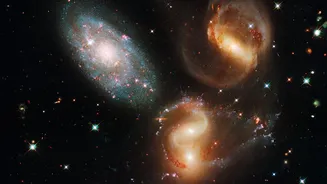
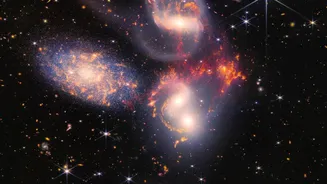
One of the biggest puzzles in modern astrophysics is how supermassive black holes in the early universe got so big, so fast. Standard models suggest that black holes grow by slowly sipping on interstellar gas, a process that takes a very long time. Yet, observations have consistently revealed behemoths already in place when the universe was less than a billion years old. This discovery provides strong evidence for a much faster growth method: galactic mergers. The theory is that as young galaxies frequently collided and merged, their central black holes would sink toward the new galactic center. These chaotic mergers would violently stir up gas and dust, providing a massive, all-you-can-eat buffet that allows the black holes to grow at an accelerated rate.
A Gravitational Dance to the End
The J0148-4214 system appears to be a perfect laboratory for this merger-driven growth model. It is likely a snapshot of multiple galaxies in the process of combining into one. The two central black holes are on an eventual collision course, expected to merge within a few hundred million years. The third, more distant black hole could be the remnant of a previous merger or might also be spiraling inward to join the party. This process of black holes coming together is crucial, as each merger not only creates a more massive black hole but also releases a tremendous burst of energy in the form of gravitational waves. As one researcher noted, this finding suggests that the early universe was efficient at bringing massive black holes together.