





A Gateway in the Clouds
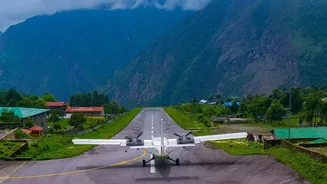
At an elevation of 3,256 metres (10,682 feet) above sea level, Leh's Kushok Bakula Rimpochee Airport holds the distinction of being India's highest commercial airport and one of the highest in the world. Named after the revered 19th Kushok Bakula Rinpoche,
a spiritual leader and statesman, the airport is carved into a mountain valley, offering passengers one of the most scenic and breathtaking landing experiences anywhere on the globe. This dual-purpose airfield serves both civilian passengers and the Indian Air Force, making it a point of immense strategic importance given its proximity to sensitive border areas. For much of the year, when heavy snowfall closes the high mountain passes, this airport becomes the sole entry and exit point for the entire Ladakh region, truly functioning as its primary gateway to the rest of India and the world.
The Challenge of High-Altitude Aviation
Operating aircraft at such an extreme altitude is a specialised skill that presents significant challenges. The thin air reduces engine thrust and aerodynamic lift, meaning aircraft need to approach at higher speeds and require longer distances for takeoff and landing. Pilots must undergo specific training to navigate the treacherous mountain terrain, which requires a visual approach without the aid of a standard Instrument Landing System (ILS). Flights are almost exclusively scheduled for the morning. This is to avoid the strong, unpredictable mountain winds that build up in the afternoon, which can make landings and takeoffs perilous. In recent years, unusually high summer temperatures have also led to flight cancellations, as hotter air is even less dense, further complicating aircraft performance and safety margins. Due to the unique operational constraints, all takeoffs are performed from one end of the runway and all landings on the other, a regulation dictated by the challenging terrain.
More Than an Airport: A Regional Lifeline
The airport's importance extends far beyond tourism. It is a critical lifeline for the Ladakhi people, ensuring a steady flow of essential supplies, enabling access to advanced medical care, and facilitating administrative connectivity throughout the year. Originally built as a military airfield, it continues to play a vital role for the Indian Armed Forces, providing logistical support and enabling troop movement in this strategically crucial border region. Before it opened to commercial flights, Ladakh was largely isolated for several months each winter. The introduction of civilian air travel transformed the region, opening it up to tourists, researchers, and mountaineers, which in turn provided a significant boost to the local economy. This dual civil-military role underscores its status as an indispensable piece of national infrastructure.
Looking to the Future: A New Era of Connectivity
To meet growing demand from tourism and enhance its strategic capabilities, Kushok Bakula Rimpochee Airport is undergoing a major expansion. A new, state-of-the-art integrated terminal building is under construction and nearing completion, with officials targeting a July 2026 opening. The new terminal is designed to handle a significant increase in passenger traffic, with projections aiming for 3 to 3.5 million passengers annually, a substantial increase from the current capacity. This modern facility will feature aerobridges to streamline boarding, expanded check-in and security areas, and commercial spaces designed to showcase local Ladakhi products and handicrafts. One of the most innovative features is a geothermal heating system, a sustainable solution for managing the extreme cold, making it one of the first airports in India to adopt such green technology. This expansion is set to triple the airport's flight handling capacity, paving the way for a new era of connectivity and growth in Ladakh.