


Why Your Equipment Matters
Before you even take a step, your success depends on your gear. It's a common mistake for beginners to grab any pair of poles, but Nordic walking poles are distinct from their trekking or hiking counterparts. Unlike trekking poles, which are primarily
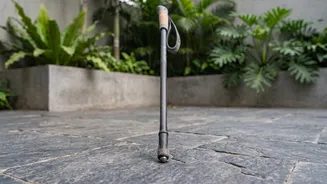
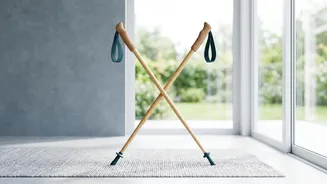
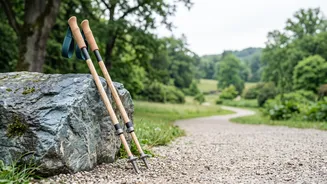
for stability and held in front of the body, Nordic poles are designed for propulsion. They feature a unique glove-like strap system that allows you to push off through the strap itself. This facilitates the specific arm swing and hand-release technique that defines the sport. When choosing poles, consider materials. While pure aluminium is common, it can transmit vibrations into your joints. Poles with a carbon component offer better shock absorption, making for a more comfortable experience.
Calculating the Perfect Pole Length
Pole length is critical for maintaining good posture and achieving an effective push-off. If your poles are too long, you may hike up your shoulders and strain your upper body. If they are too short, you are likely to slouch forward, compromising your posture and compressing your chest. There's a simple formula to find your ideal starting point: multiply your height in centimetres by 0.68. For example, a person who is 170 cm tall would need poles around 115 cm long. Another way to check is to stand with the pole tip on the ground; your elbow should form a 90-degree angle or slightly wider. Adjustable poles offer the flexibility to fine-tune this length as your technique improves or when walking on varied terrain.
Mastering the Core Technique
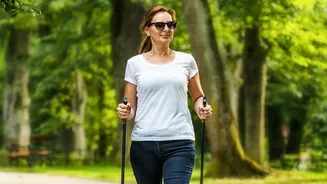
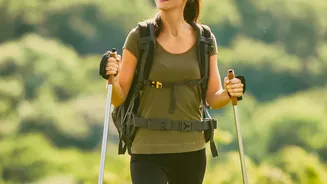
Nordic walking should feel like a natural extension of regular walking, but with an added upper-body rhythm. The movement is based on a contralateral pattern, meaning your opposite arm and leg move forward at the same time (right leg with left arm, and vice versa). Stand tall, keeping your spine long and shoulders relaxed. Your arm swing should originate from the shoulder, not the elbow, and remain relatively straight. As you step forward, plant the opposite pole between your front and back foot. The key is to push the pole backward, propelling yourself forward. As your arm swings behind your body, open your hand to release the grip, pushing through the strap. This grip-and-release motion is fundamental to a powerful and fluid stride.
Common Mistakes and How to Fix Them
Many beginners make a few common errors that reduce the effectiveness of the workout and can cause discomfort. One is planting the pole too far in front of the body, which acts as a brake instead of a propeller. Remember to plant the pole beside you, in the middle of your stride. Another frequent issue is walking in a 'pacing' or 'amble' pattern, where the same-side arm and leg move together. To fix this, try dragging the poles behind you while walking naturally to re-establish the opposition rhythm. Finally, avoid a death grip on the poles. Keeping your hands tense restricts arm swing and can tire you out. Practice the open-hand release as your arm moves past your hip to ensure a full range of motion.
The Payoff: Benefits of Good Form
When you get the technique right, Nordic walking transforms from an awkward motion into a powerful, low-impact exercise. Proper form engages up to 90% of your body's muscles, turning a simple walk into a comprehensive workout that targets your legs, core, back, and arms. This increased muscle engagement leads to a higher heart rate and greater calorie expenditure compared to regular walking. By using the poles to propel yourself forward, you also reduce the load on your knees and other lower-body joints, making it an excellent activity for individuals seeking a high-intensity workout without high-impact stress. Good posture, a fluid arm swing, and the right pole length are the keys that unlock these full-body benefits.