



Cosmic Misfits: What Are Brown Dwarfs?
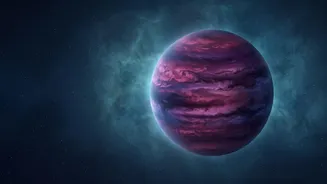
Imagine a star that never quite made it. That, in essence, is a brown dwarf. They form from collapsing clouds of gas and dust, just like stars do. However, they never accumulate enough mass to kickstart the nuclear fusion of hydrogen in their cores, the process
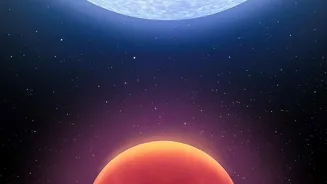
that makes stars like our sun shine brightly. While they are not massive enough to be stars, they are considerably larger than planets, typically ranging from 13 to 80 times the mass of Jupiter. Because they don't have a sustained internal engine, they simply cool down and fade over time, glowing dimly with the leftover heat from their formation. This has earned them the nickname 'failed stars', and they drift through the cosmos as solitary, faintly glowing wanderers.
A Glimpse Through the Clouds
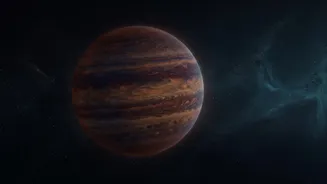
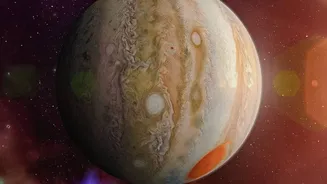
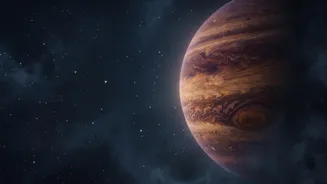
The atmospheres of brown dwarfs are fascinatingly complex places, more akin to the giant planets in our own solar system than to stars. They are turbulent, with clouds made not of water, but of exotic materials like silicates—essentially grains of sand. These clouds whip around the fast-spinning orbs, creating a mottled, patchy appearance. Until recently, much of our understanding of their chemistry came from theoretical models. Observing them is challenging because they are so dim. Recent advancements, however, have allowed scientists to probe these atmospheres with unprecedented detail, analyzing the light that filters through breaks in the cloud layers to decipher the chemical cocktail within.
NASA's Breakthrough Observations
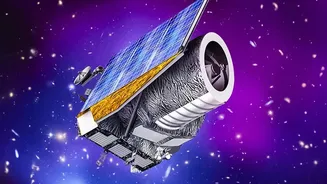
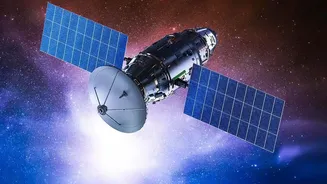
Recent discoveries, particularly from NASA's James Webb Space Telescope (JWST) and the SPHEREx telescope, have revolutionized our view of these objects. The SPHEREx mission, launched in 2025, has analyzed dozens of brown dwarfs, confirming their atmospheres are rich with familiar molecules like water, methane, carbon monoxide, and carbon dioxide. More startlingly, JWST observations have pushed the boundaries of what was thought possible, identifying brown dwarfs as small as two or three times the mass of Jupiter. In the atmospheres of these extremely low-mass objects, scientists detected an unidentified hydrocarbon—a molecule not predicted by any models and previously only seen in our solar system on Saturn and its moon Titan. This discovery suggests these tiny brown dwarfs might belong to a whole new spectral class.
Why This Matters for Finding Other Worlds
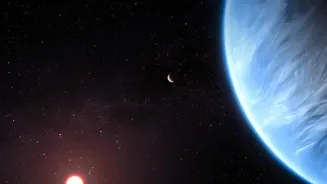
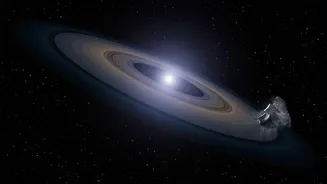
Studying the atmospheres of brown dwarfs isn't just about understanding these specific objects; it's a crucial stepping stone to understanding planets beyond our solar system. Brown dwarfs serve as a natural laboratory for planetary and atmospheric physics. Because they are isolated and not overpowered by the glare of a host star, they are easier to study than distant exoplanets. The discovery of complex molecules like hydrocarbons and phosphine in their atmospheres helps scientists refine their models of atmospheric chemistry. Understanding what happens in the atmosphere of a 2,700-degree Fahrenheit brown dwarf can provide clues about the cloudy atmospheres of giant exoplanets. Furthermore, the discovery of a planet-forming disk around a tiny brown dwarf blurs the line between planets and stars, challenging our fundamental theories of how both are formed.