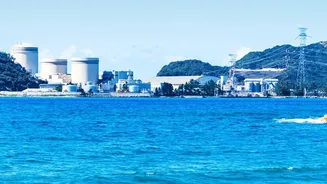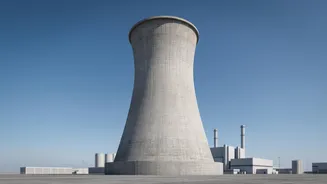







At the United Nations, the International Atomic Energy Agency (IAEA) presented its latest global nuclear outlook, sparking fresh debate. The world is at a crossroads, balancing urgent climate goals against the complex realities of nuclear power.
A Vision of Two Futures
In its
recent address to the UN General Assembly, the IAEA laid out two possible futures for nuclear energy, extending its projections for the first time to 2060. In a 'high case' scenario, global nuclear capacity could soar from approximately 377 gigawatts (GW) at the end of 2025 to 1,284 GW by 2060—more than a threefold increase. This optimistic view assumes a concerted global effort to decarbonize, strong government support, and successful technological advancements. Conversely, a 'low case' scenario projects a more modest rise to 696 GW, reflecting potential roadblocks like financial hurdles, regulatory delays, and shifting public opinion. These are not firm predictions, but scenarios that illustrate the critical choices facing policymakers today.
The Climate and Energy Security Catalysts
The primary driver behind this renewed interest is the dual pressure of climate change and energy security. As nations strive to meet net-zero emission targets, nuclear power's ability to provide constant, low-carbon electricity makes it an attractive alternative to fossil fuels. In 2025, nuclear reactors produced about a quarter of the world's low-carbon electricity. Furthermore, geopolitical instability has highlighted the vulnerability of energy supplies dependent on imported oil and gas, pushing countries to seek more stable, domestic sources of power. IAEA Director General Rafael Grossi also pointed to new drivers, including the massive energy needs of AI-powered data centres and the tech industry's hunger for reliable, clean power.
Significant Hurdles Remain
Despite the high-growth potential, the path to a nuclear renaissance is fraught with challenges. The enormous upfront cost and long construction timelines of traditional large-scale reactors remain a major deterrent for many nations. Public perception, shaped by past accidents like Chernobyl and Fukushima, continues to be a significant factor, alongside the unresolved issue of long-term radioactive waste storage. Even with robust national targets in place, the World Nuclear Association notes a major gap between ambition and execution. To triple capacity by 2050, the global construction rate for new reactors would need to increase to a level six times higher than it is today, demanding a monumental scale-up in financing, supply chains, and skilled workforces.
The Shifting Global Landscape
The momentum for nuclear growth is not uniform across the globe. Asia, particularly China, is leading the expansion. Meanwhile, some European nations are phasing out their reactors, though others are reconsidering nuclear power to meet climate goals. A key part of the future outlook involves innovative technologies, especially Small Modular Reactors (SMRs). The IAEA projects that SMRs could account for nearly 28% of new nuclear capacity by 2060 in its high case. These smaller, factorybuilt reactors promise lower costs, faster deployment, and greater flexibility, potentially opening up nuclear power to more countries and for new applications, like industrial heat.
India's Ambitious Nuclear Road Map
This global conversation resonates strongly with India's own energy strategy. With one of the world's fastestgrowing economies, India faces the immense challenge of ensuring energy security while pursuing clean development. The Indian government has set a bold target of increasing its nuclear power capacity from its current level of around 8.8 GW to 100 GW by 2047. This expansion relies on both large conventional reactors and the indigenous development of Small Modular Reactors. Earlier in 2026, India achieved a major milestone with the successful criticality of its first indigenous Prototype Fast Breeder Reactor, a key step in its longterm,
threephase nuclear program designed for energy independence. Achieving the 100 GW goal will require an unprecedented acceleration in construction and a shift from viewing nuclear as a strategic asset to building a fullfledged industrial sector around it.