



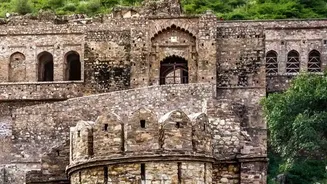
Mehrangarh Fort: The Citadel of the Sun
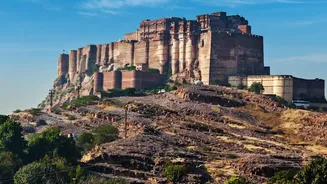
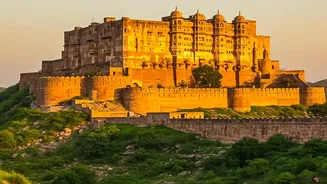
Perched on a 400-foot cliff overlooking the blue city of Jodhpur, Mehrangarh Fort is a staggering display of architectural might. Founded in 1459 by Rao Jodha, the fort seems to rise organically from the rock it stands on. Its massive walls, which are
up to 36 meters high in places, have withstood centuries of conflict, and the marks of cannonball fire can still be seen on its gates. But behind the imposing facade lies a series of palaces known for their intricate carvings, expansive courtyards, and delicate latticework. Palaces like the Moti Mahal (Pearl Palace) and Phool Mahal (Flower Palace) showcase the opulent lifestyle of the Rathore rulers. The fort's story is also tinged with legend; its very foundation is said to be built upon the willing sacrifice of a man named Raja Ram Meghwal, whose family was promised care by the king in return. This blend of raw power, delicate artistry, and folklore makes Mehrangarh a quintessential Rajput hill fort.
Murud-Janjira: The Unconquered Sea Fortress
Standing on an island in the Arabian Sea off the coast of Maharashtra, Murud-Janjira tells a completely different story. This is not a hill fort, but a formidable marine bastion—a 'Jal Durg' or water fort—that remained unconquered throughout its history. Built in the 16th century by the Siddis, who were of Abyssinian origin, the fort withstood attacks from the Marathas, Mughals, and Portuguese. Its location and design were its greatest strengths. The main gate is hidden from view and only becomes visible at close range, a clever trick to foil invaders. Its 26 rounded towers were designed to repel cannon fire, and remarkably, the fort contained freshwater lakes and wells, allowing its defenders to survive long sieges. Murud-Janjira is a testament to incredible maritime engineering and the unique history of the Siddi community in India, a story written on water and stone.
Golconda Fort: Where Diamonds and Acoustics Meet
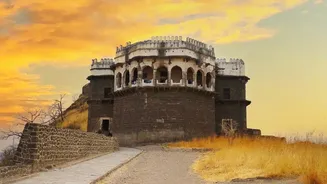
Moving south to Hyderabad in Telangana, Golconda Fort offers another unique narrative. Originally a mud fort, it was transformed into a massive granite citadel by the Qutb Shahi dynasty. While a powerful military structure, Golconda's fame rests on two other pillars: diamonds and acoustics. For centuries, this was a global centre for the diamond trade, with legendary gems like the Koh-i-Noor and Hope Diamond passing through its vaults. This trade brought immense wealth, which is reflected in the fort's grand palaces and mosques. Its other marvel is its engineering. Golconda features a revolutionary acoustic system where a clap at the main gate can be heard clearly at the highest point of the fort, nearly a kilometre away. This served as an ingenious warning system. The fort is a perfect blend of military strategy, commercial might, and scientific innovation, showcasing a different kind of power.
Chittorgarh Fort: A Saga of Valour and Sacrifice
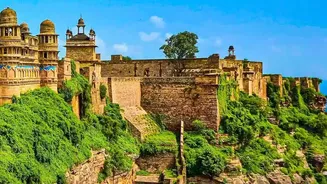
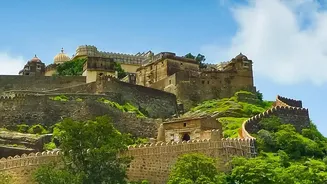
Perhaps no fort is as steeped in legend and tragedy as Chittorgarh in Rajasthan. As one of the largest forts in India, it is less a single structure and more a fortified city, spread across a vast hilltop. Its history is marked by three major sieges, in 1303, 1535, and 1568. Each siege ended with the Rajput warriors performing 'Saka', a final ride into battle from which there was no return. Famously, the women of the fort, led by figures like Rani Padmini and Rani Karnavati, are said to have committed 'Jauhar', or mass self-immolation, to avoid capture and dishonour at the hands of the invading armies. While its palaces and temples, like the magnificent Vijaya Stambha (Victory Tower), speak of royal grandeur, the true story of Chittorgarh is written in the valour of its people. It stands as a powerful, and somber, symbol of Rajput pride and resistance.