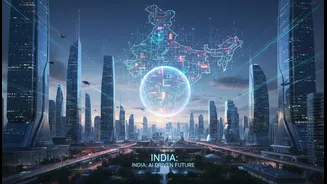










From Global Back Office to Innovation Partner
The long-standing story of India’s IT industry is one of unparalleled success in providing software development, system maintenance, and business process outsourcing for global clients. This model, built on a foundation of lower costs and a large English-speaking
workforce, transformed the nation's economy. However, the phrase “moving up the value chain” signifies a fundamental evolution. It describes the shift from being an executor of tasks to becoming a strategic partner that drives innovation. Instead of focusing on cost-driven outsourcing, the goal is to deliver value-driven solutions, moving from manual processes to intelligent automation and from traditional software to AI-powered platforms. This means Indian IT firms would focus less on managing a client's existing infrastructure and more on co-creating new, high-value digital and AI solutions.
The AI-Powered Leap
Enterprise AI is the catalyst for this transformation. It goes far beyond simple automation by enabling intelligent systems to handle complex, routine IT tasks like software testing, debugging, and system monitoring. Generative AI tools are now acting as co-pilots for developers, accelerating coding and prototyping, which significantly reduces time-to-market. This automation frees up human talent to concentrate on more strategic, creative, and complex roles, such as high-level consulting, solution architecture, and client advisory. The opportunity lies in creating bespoke, industry-specific AI solutions that solve core business problems for clients in sectors like finance, healthcare, and manufacturing. This pivot is already creating new demand for services in data readiness, application modernisation, and AI governance.
Adoption Is Accelerating
Indian enterprises are no longer just experimenting with AI; they are embedding it into their core operations. Reports from 2026 show that a significant percentage of Indian companies are leading their global peers in at-scale AI adoption across functions like product development and marketing. One report noted that 40% of Indian organisations reported significant or full AI usage compared to a global average of 28%. This is driven by a focus on improving customer experience and operational efficiency. Major IT service providers have launched massive upskilling initiatives, with some training hundreds of thousands of employees in AI principles and announcing billion-dollar investments to build out their capabilities.
The Reskilling and Governance Challenge
Despite the momentum, significant hurdles remain. The primary challenge is a profound workforce transition. As AI automates lower-skilled work like basic coding, demand is shifting toward employees skilled in design, data science, cybersecurity, and user experience. While companies are investing heavily in reskilling, a gap persists between the pace of AI adoption and workforce readiness. One recent study found that while 57% of Indian organisations have integrated AI into core processes, only 23% of leaders feel their workforce is fully prepared. Furthermore, as companies race to deploy AI, they face challenges in establishing robust governance to manage risks related to data security, privacy, and regulatory compliance.
A New Business Model Emerges
AI is also forcing a change in how IT services are sold. The traditional model, based on time and materials or the number of employees on a project, is becoming obsolete for AI-driven work. Clients are increasingly reluctant to pay for services that generative AI can perform more efficiently. This is pushing the industry toward outcome-based contracts, where payment is tied to achieving specific business results. This shift puts pressure on profitability but also rewards firms that can deliver tangible value. The future will likely see Indian IT companies acting as crucial partners in managing complex AI implementations, ensuring security, and integrating AI with legacy enterprise systems—areas where deep domain knowledge is a key advantage.