





A Prime Candidate for Life
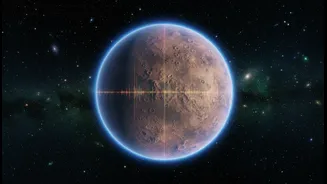
Discovered in 2017, LHS 1140 b quickly became a darling of astronomers. Located about 49 light-years away, it's a 'super-Earth'—a rocky planet significantly larger and more massive than our own, with about 5.6 times Earth's mass and a radius 70% larger.
It orbits a small, cool red dwarf star, which are the most common type of star in our galaxy. Crucially, it orbits within the star's 'habitable zone'. This is the so-called 'Goldilocks' region where temperatures are just right for liquid water to potentially exist on a planet's surface, a key ingredient for life as we know it. Its density suggests it might be an ocean world, with a significant fraction of its mass being water.
The Challenge of Red Dwarfs
While being in the habitable zone is exciting, orbiting a red dwarf comes with challenges. These stars are known for their volatility, often blasting their nearby planets with intense X-ray and ultraviolet radiation. This high-energy bombardment is capable of stripping away a planet's atmosphere over time, a process that could render a world sterile and barren. Many rocky planets discovered around red dwarfs have appeared to be airless, raising the question of whether these worlds could hold onto their atmospheres long enough for life to emerge. The star LHS 1140 b orbits is thankfully a relatively quiet and old one, giving the planet a better chance of survival.
A Cosmic Gas Leak Detected
In a major breakthrough, astronomers announced they have detected the first confirmed atmosphere around a rocky planet in the habitable zone. They didn't see the atmosphere directly. Instead, using the Magellan Clay Telescope in Chile, they spotted a telltale sign: a cloud of helium gas escaping from the planet's upper layers. As LHS 1140 b passed in front of its star, a technique known as transit spectroscopy allowed scientists to see the signature of helium filtering through the starlight. This was described as the strongest evidence yet that a rocky, potentially temperate planet can retain an atmosphere for billions of years.
Why Is the Atmosphere Escaping?
The helium is being pushed away from the planet by the intense radiation from its host star. Even a quiet red dwarf emits enough high-energy radiation to heat the upper atmosphere and cause lighter gases like helium to achieve escape velocity, slowly bleeding off into space. Interestingly, observations in 2024 detected the escaping helium, but follow-up observations in 2025 did not, suggesting the atmospheric escape is variable and might be linked to the star's own activity levels. During the same observation period, the system's other known planet, LHS 1140 c, showed no signs of an atmosphere, suggesting it may have lost its own long ago.
A Paradoxical Path to Habitability
An escaping atmosphere might sound like bad news for a planet's habitability, but for LHS 1140 b, it could be a positive sign. The presence of helium in the upper atmosphere, but a depletion of lighter hydrogen, suggests a fascinating possibility. Scientists theorize that heavier gases, like water vapor and carbon dioxide—critical for a stable climate and liquid water—might be trapped in the lower atmosphere, closer to the planet's surface. The escaping helium could be a sign that the planet is shedding a primordial, hydrogen-rich atmosphere it was born with, revealing a secondary, more life-friendly atmosphere underneath. It’s a planetary transformation in action.
What Comes Next for LHS 1140 b?
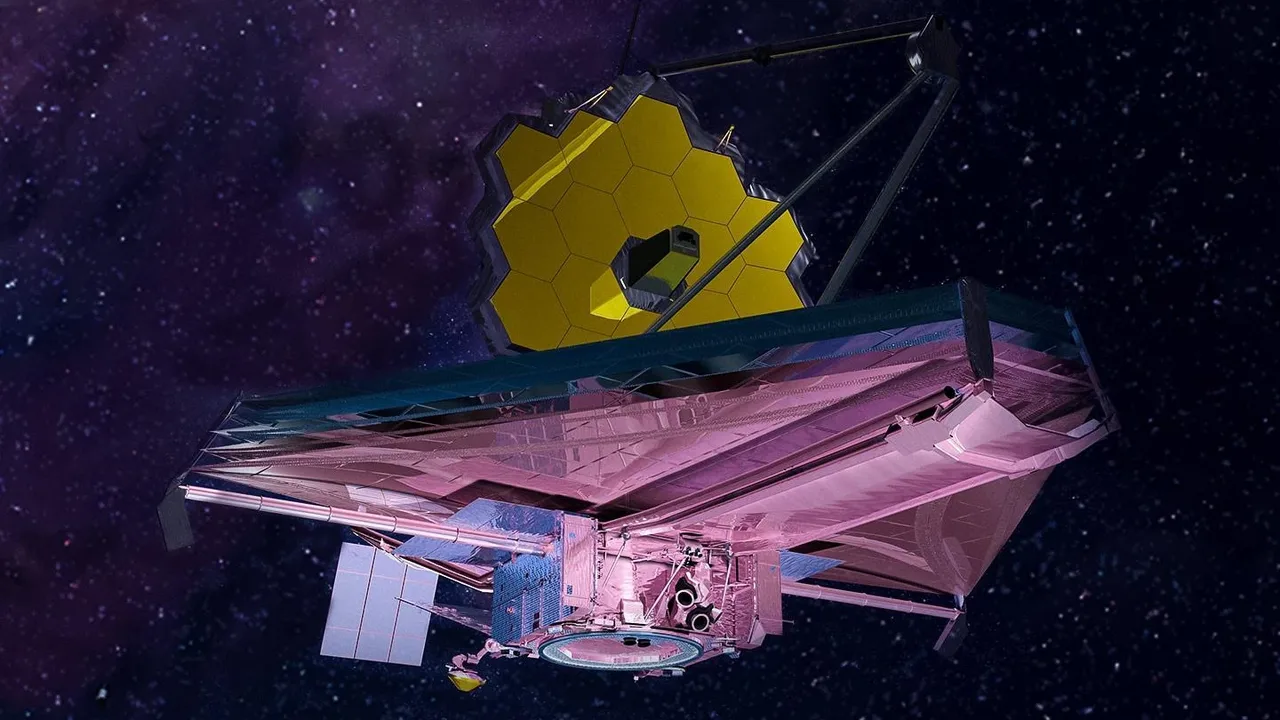
This discovery firmly places LHS 1140 b at the top of the list for future study. With confirmation that it has an atmosphere, it now meets all three top-level requirements for habitability: it is rocky, it has the right temperature for liquid water, and it has an atmospheric shield. Telescopes like the James Webb Space Telescope (JWST) and Hubble will continue to observe this world, hoping to parse the full composition of its atmosphere. The ultimate goal is to search for biosignatures—gases like oxygen, methane, or carbon dioxide in proportions that could hint at the presence of life. While there's no evidence of life yet, LHS 1140 b has become our best laboratory for finding it outside the solar system.